Jobs: A Story, Maybe

I started my first job in 1996 when I was newly 16. It was at an old general store in the town of Readsville. A town so forgotten, there wasn’t even a post office back then. My duties included, but were never limited to:

-Slicing deli meats and cheeses from huge blocks and making sandwiches for old men who had very particular ways of wanting their sandwiches, for example, the cheese against one piece of bread with a slice of ham on top and then the other piece of bread with a slice of ham on top and nary shall the two sides meet to form a sandwich. This was so he could shake out at least a tablespoon of black pepper onto both sides and about half of it on the counter

-Pumping gas if someone came in asking me to or looked like they really needed help

-Selling Marlboro Reds to people using food stamps (no one told me I wasn’t supposed to)

-Running down the janky steps into a probably haunted basement just to scream while trying to use a tiny net to fish out a dozen minnows for bait in a tub way too large for the amount of tiny minnows that lived in it

-Praying that no one came in the store while I had to pee since the toilet was in that same basement, literally in the middle of the room with no walls

-Calling 911 for a few car wrecks

-Giving directions to lost city folk who’d wandered too far off I-70.

-Listening for hours as my lady boss (and owner) talked to me a mile a minute with garlic breath about anything and everything. It ranged from local gossip to what I now understand as conspiracy theories. Overall, she was a wonderful woman (Because when you worked, you could eat and drink ANYTHING you wanted for free!)

-Adding things to peoples’ tabs which was just a scrap of paper dangling from a nail behind the register

The cash register was really old, so it made the “cha-ching” noise when the drawer shot open. What I loved most was the feeling of pushing it back in with my hip when my hands were full of cig cartons. Minimum wage rose that year, so my pay went from $4.25 to $4.75 an hour. I think I worked there about a year before I found a job in Fulton at a video store: Broadway Video which eventually became Movie Gallery. That job was the ultimate dream of any kid during that decade, and yes it’s just like you imagine. The soundtrack, the baggy pants, the porn room, and me taking home tapes where two girls kiss without officially checking them out because I didn’t want anyone to know how many times I watched “All Over Me.”

But this is not about those fond teenage memories. It’s about jobs.

Specifically, it’s about not having one.

I was laid off on November 17th, so just about a month ago. It wasn’t completely unexpected, but it still stung and felt a little personal. That job was the most money I’d ever made and the company seemed to be one with great stock options and unlimited growth and all those corporate words. But. I only got to be there about a year and a half.

I’ve been working since I was 16 (nearly 30 years), and still have, what?, like, 20 more to go? Does this shit never end?

I began to say this is the longest I’ve ever been without a job, but I do still have a job; I’ve been coaching at my gym for a year and a half. Generally, it’s just about 5 hours of work a week, but I’ve been asking for more classes since I was laid off. I guess I enjoy it so much, I forget to call it work.

But you know what I mean.

My last week doing archaeology was really lovely. It was in southern Illinois on more than a thousand acres of mostly wooded areas with rolling hills and a large creek that we passed through several times. For the seven days I was there, I dug about 150 holes, always got my 10,000 steps in, enjoyed shimmying under barbed wire fences and over felled trees. I basked in the sunlight and some days when it was 65 degrees and felt my cold nose when it was only 39, windy, and overcast. I was so grateful for my body, which is 45, to be able to not only keep up with the 25 year old techs, but for being able to out walk them. Out maneuver them in the woods.

You’re wondering what the plan is now, I bet. My health insurance runs out December 31. Not just mine, but the whole family’s. I have archaeology applications in. My previous job is hiring, but kind of not because of a hiring freeze. It sucks that this country’s healthcare is attached to jobs. It sucks that I can’t just already own a massive piece of land I could try to build a tiny cabin on and spend my days as a content hermit.

I guess I always thought that at this age, I’d be more successful. In the sense that my job would be permanent and fixed, that I’d have nothing to worry about. That I’d be doing something I loved and was really good at. I feel like maybe the stories of the 1980s were too influential on me. I always pictured myself a frazzled, yet competent career woman wearing a power suit with those linebacker shoulder pads. I thought I’d be in some position where people would, like, have to call me because I’d be the expert on whatever it was. I’d be someone who’d get a call, roll up in my official vehicle, take off my sunglasses and say, “show me where it is,” and people would be relieved I was finally there. Or something like that feeling. You know?

When I was little I wanted to be:

  • a professional baseball player (obviously the Cardinals)
  • an archaeologist
  • a writer

I’ve achieved two of those three, and I think I can substitute rugby player of several decades, coach, and referee for baseball. In some ways, I’ve accomplished everything I ever set out to do. But in other ways, and most of the time, I still feel like I haven’t done anything. I still haven’t done “IT.” And I can’t quite figure out what IT is.

I still haven’t written the great American novel. I’m still not a scientist who gets called in to testify during intense trials or interviewed for PBS specials. The closest I got to being a Cardinal was getting to stand on the field at Busch Stadium while Cyrus ran the bases. The tears I shed were of joy and for myself-not my kid.

As I’m probably past the middle point of my life, I’ve been doing a lot of reflecting on my life up until now.

Would Christina, the weird girl who used to write poetry by the river, the 16 year old who spent hours alone in the 100 year old general store in the middle of rural Missouri dreaming of the rest of the entire world… would she think I’m cool? Would she like me or be proud of me? Would she want to be me?

I’m wise enough to know things never turn out the way we plan, but I’m not spiritual enough to believe things turn out the way they’re supposed to by some grand design. And I’ll die before saying, “it is what it is.”

I guess there’s no moral to the story here, today. And there doesn’t have to be. Sometimes a story is just a sequence of events with no unifying theme.

Sometimes it just takes a while to piece it all together.

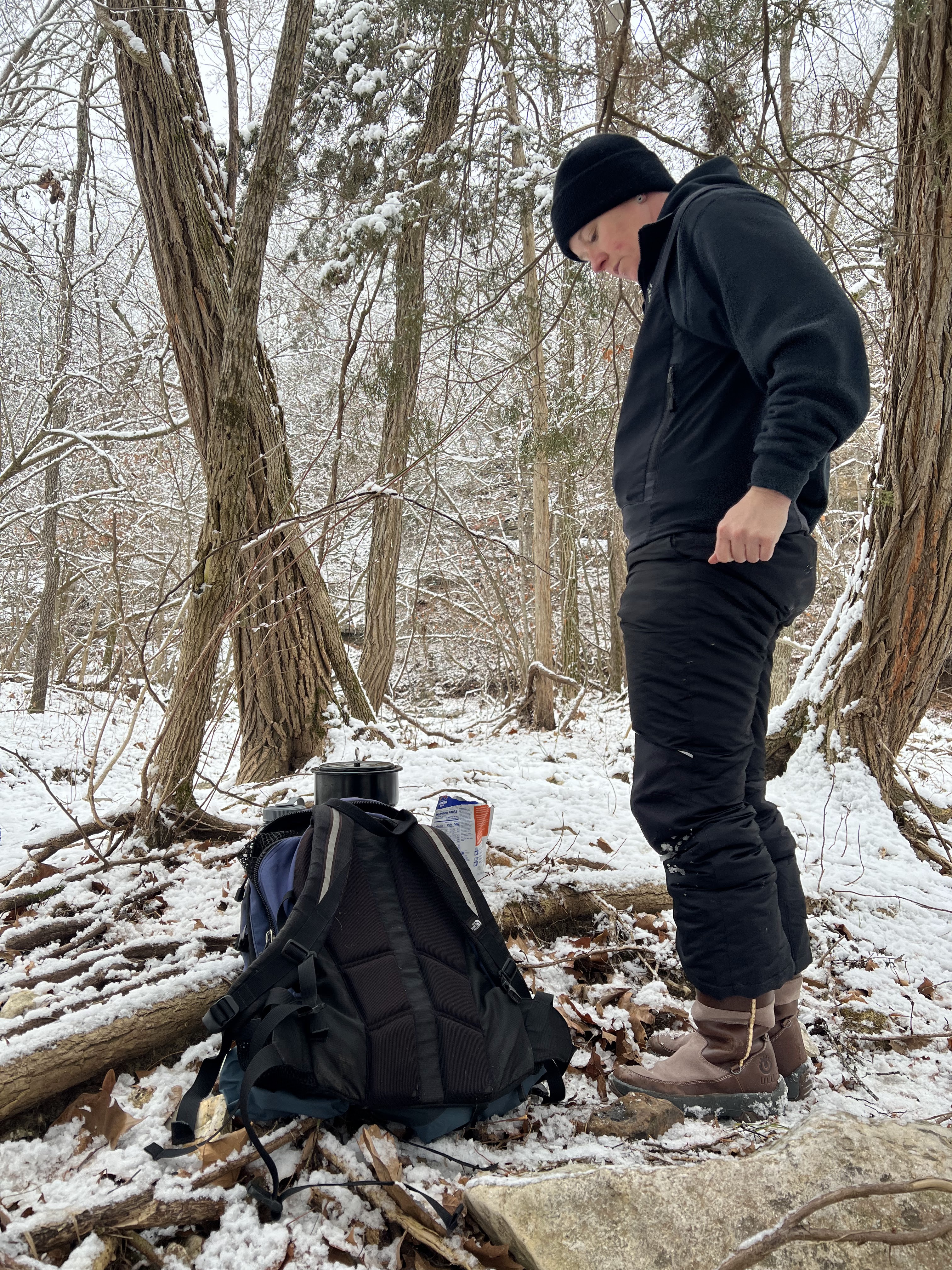
One of the last photos I took on what might be my last ever adventure in archaeology.

The Growing Season

There are days when I feel like I’ve already done it all and also have done nothing with my life. My smallness in this vast universe has been feeling like a giant foot about to smash me. Not in the cartoonish Monty Python sense but in a more, and very much not funny way. Maybe like the way Charlie and his grandpa are being sucked up into the ceiling with those blades just spinning, but no amount of burping can bring me back down from that inevitability. None of us can stop it. We’re all just slowly floating up and up.

I am terrified of death. And I can’t imagine that you’re okay with it.

I guess there’s some irony here as I’m sitting out on my sunny porch in my comfortable house looking over our newly planted garden full of sprouting possibilities and wholesome nourishment. Gaby and I are healthy, though absolutely middle aged and exhausted. Our kids are doing alright. Our parents, well, that’s a bit more complicated, but overall, okayish.

Maybe it’s just that I don’t know what to do next. Or what is coming next. Erika will be 21 in just a few weeks, and Cyrus is already 15. I’m not here saying that raising kids was my life’s mission, but that has been my sole focus for 15 years. I question my parenting daily. My goal has always been to not screw them up too bad. Or at least, let them know I love them even though I’m not good with words (I know, right?) and I’m definitely not good with physical affection.

I have spent the majority of my life trying to be good. Most times I have tried to be the best. In sports, and more tangible pursuits, those are so easy to measure. Did I run faster? Did I score more points?

For the things that really matter, though, what’s the measurement? Am I a good and loving daughter? Am I a caring and supportive partner? Am I the parent my kids can come to with anything and feel safe? I know I’m not a great friend because I’ve lost touch with almost everyone. Maybe that’s how it is as you get older. Maybe that’s just how I am. Maybe all of you are out there doing a much better job at all of it.

Maybe our new neighbor has just caught me wiping tears from across our backyards and asked if I’m doing alright. I said I was good. He lingered, then made the sign of the cross at me, like a priest. “God bless,” he said.

Ass in Chair

I can’t believe it’s been almost two years since I started my cookbook project. And I can’t believe it’s been that long since I’ve written anything.

Well, that’s not totally true. I’ve put some creative energy into writing a few songs, but that’s about it.

I’ve never been a disciplined writer even though the only reason I went school for creative writing, Dr. Derick Burleson, was a huge proponent of the technique of “ass in chair.” It’s exactly what you think; just sit down and fucking write something. Anything.

But that’s always been tough for me when I don’t have much to say. Of course “having something to say” isn’t the only reason to write. And, honestly, it shouldn’t be the motivation, either.

I’ve had a lot to say over the years. I’ve written to you about the whole ordeal of having a premature baby, just bleeding feelings all over the place. I’ve written to you countless times about being queer and from the country. I’ve told you family stories. I made old recipes for you and wrote down my feelings about that, too. I’ve tried to tie in my own experiences of being a person in this world with current politics. So, maybe it is in that spirit that I felt the need to put my ass in a chair tonight. Or maybe I just felt like telling you some stories.

Here’s a story: my dad now only has one ear. What happened? Skin cancer. A lump that a doctor told him was a cyst and would go away on its own. And the doctor, treating him like a total blathering old man, said to him, “You know, you don’t have to come in for every little thing.” And within a few months, here’s my dad with a patch of his leg skin slapped to the side of his head in the place of his ear. I mean, the skin is ear-shaped, but just flush with the rest of his head. And a long scar running down his neck where they took some lymph nodes. And a long scar on his forearm where they took an artery. Did I mention that he’s deaf in his other ear? So, he has one ear that looks normal and can’t hear and one ear that is missing that’s doing all the heavy lifting.

He starts radiation on Monday-his 76th birthday.

I can’t believe my dad is 76. I can’t believe I’m 45. I don’t want to believe that I live in a crumbling democracy, late stage capitalism hellscape, but here we all are.

Here’s another story: Last May I started two new jobs; I’m really good at one of them and at the other one, everyone got a raise except me.

Here’s another: I’m positive I’m neurodivergent.

And one more: What are we even doing with ourselves? My desire to live off grid increases constantly. I’m not, and have never been a prepper, but I understand the appeal. I do have some scarcity trauma that I believe I inherited from my parents, so having a stocked fridge, pantry, and freezer makes me feel safe. Gaby can preserve almost anything, so I’m confident we’d do okay. But I realize now that preppers aren’t preparing for the worst; they’re preparing for their dream.

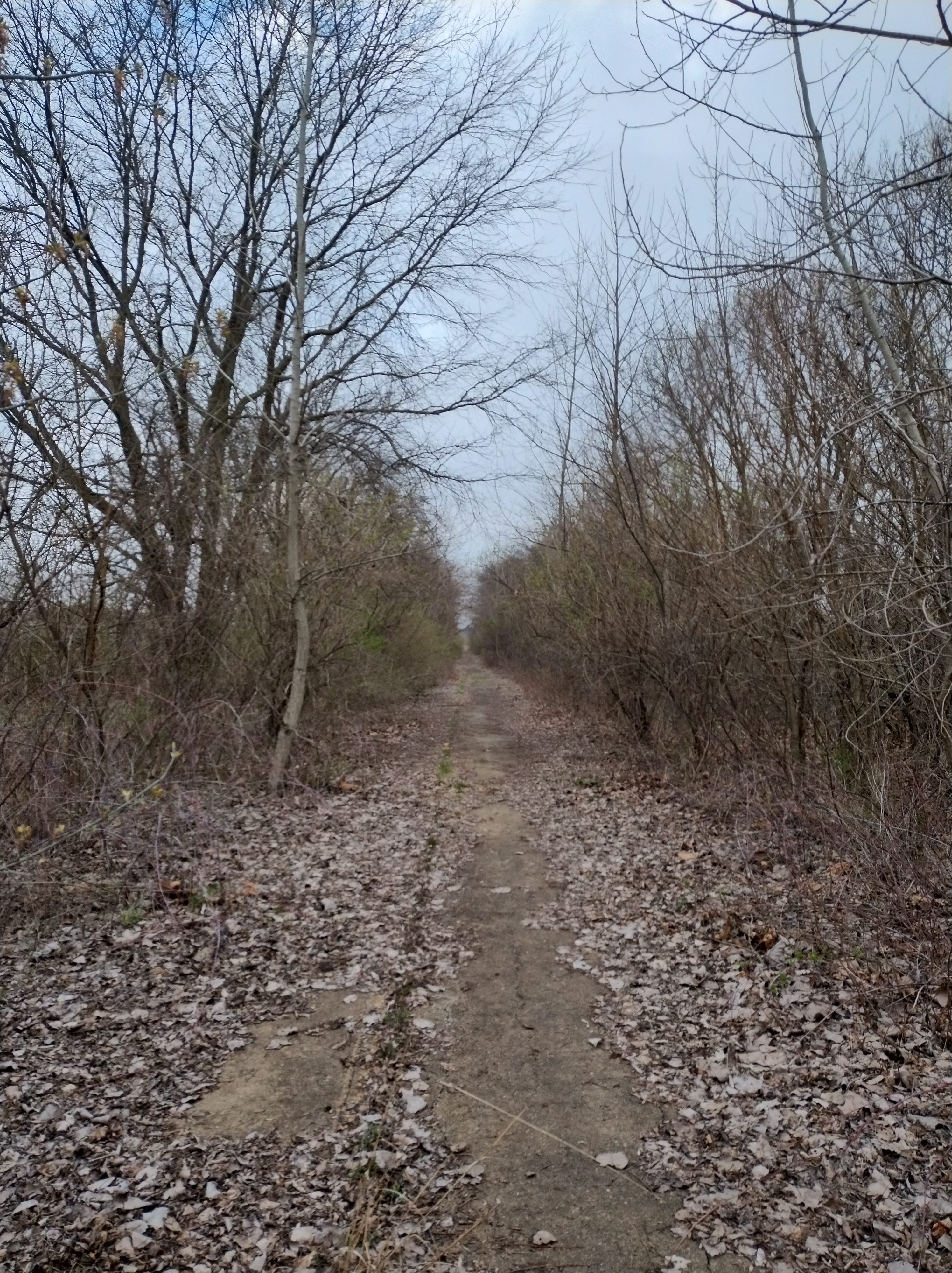
Last week I was out in the field doing archaeology. My coworker and I came across an abandoned road that ran through the middle of two soybean fields. The trees had made a canopy over the top and leaves and grass had crept up on both sides leaving only a narrow strip of visible concrete. You could see the yellow middle lines still but that was about it. There was dumped trash like tires and tarps and random old lamps. A plastic Christmas decoration. Beer bottles and cans. A bag overflowing with used pads and tampons. Three early 2000s flat screen tv’s. And we wondered when was this road shut down? We dig a little digital digging and found out the road was being used until 2005. In just 20 years, nature had almost reclaimed the whole thing. At one point as I watched my coworker walk down the road in front of me, I commented that I felt like we were in the Walking Dead.

I have fantasized that civilization crumbles and we have to start over so many times, and those times are ever increasing in frequency and length. Don’t get me wrong; I love theatres and cultural exchange. But. What if our cell phones died and there were no more 20 second videos of people talking in that weird voice? What if we all knew how to grow and hunt things and we shared that knowledge with our neighbors and kids? Wouldn’t it be lovely to spend your days actually surviving instead of just being in survival mode surrounded by traffic noise and Teams notifications? What if you never had to write another email?

I know. Don’t worry. I’m not that naive. Both of my parents spent most of their childhood without running water. And here I am making video calls on a small rectangle that fits in my pocket.

I suppose that’s why I’ve always been fascinated by history and studied archaeology. There was once a time with only rocks and sticks and people not only survived, but created art, had meaningful lives, and had enough time left over for religion and story-telling. Of course life was shorter and harder than it is now. They lived without quality healthcare and vaccines.

I just can’t understand how we’ve come so far and yet remain so far away.

Pomp and Circumstances

In 1997, I was unabashedly enjoying the resurgence of swing music, dealing with the nuclear family fall-out of being gay, and trying to apply to college. 

My parents stopped at a high school education, and we were all at sea about how to apply, what forms to fill out for scholarships, and all that horrible stuff. We also weren’t getting along…because I’d come out. Not “getting along” is a very nice way of saying that they threatened to kick me out, told me I was going to hell, sent me to a therapist to fix me, so we barely spoke and when we did it was shouting. I cried every day. I stayed in my room and tried to work a shift at the video store whenever I wasn’t doing some school activity. Before my gayness reared its head, I was hoping for softball scholarships. (Yes, I see the humor now).  I remember several Missouri colleges calling me with offers, but those phone calls lasted less than a minute. I’d say I’d already made up my mind on going to Houston and I’d hang up that rotary phone before they finished their pitch (pun intended). I knew I had to leave Missouri. I had to get to a big city. I had to be with my girlfriend. And all of the other people like us, or at least the people who didn’t care. 

My parents were prepared to pay if I went somewhere in Missouri, somewhere close to them, but I ordered an application from the University of Houston and had it sent to my friend’s address. I filled it out secretly at school and secretly mailed it back. When my acceptance letter came, that started another huge fight, but I was 18 and I could do whatever I damn well pleased, I told them. 

After a lot of screaming, they agreed to pay for my education despite their disdain for me. U of H was very affordable, comparatively, so that helped my argument. 

But, because I lived off campus and did not want to rely on my parents for anything more than tuition, I had a full time job. I worked 32-40 hours every week, alternating long days at school with long days selling hiking boots. I went to some of my classes most of the time. I never missed a class in anthropology or anything pertaining to literature, since I actually cared about those things. I was a terrible student, really. I barely passed a stats course and had to hire a tutor for logic. I made it out with a D and was so proud that I had proven I knew more than half of what was taught. Like most students, I stayed up all night pounding out some poorly formatted papers about literature, history, and even science. I did this on a diet of angel hair pasta, butter, and garlic powder and while living in apartments infested with mold, flying Texan roaches, and gaps so large between the window and frame that I’d stuffed them with rugby socks. 

College was a great mystery to me, like it is to most first generation college students. What I knew about it came from movies and my girlfriend–who had just started a graduate program. (I had never heard the term before).  No one forced me or expected me to go. I wouldn’t be letting anyone down if I didn’t.  It was a strange and foreign idea in a far off land. And, as one who’d always wanted to see the world, I knew I had to find my way there. 

I had an advisor as an undergrad, but he was more interested in talking about gay things with me. I know it might seem strange to younger people, but there weren’t that many out queers around unless you were in a gay bar. I managed to figure out which classes I had to take, how to register, how to pass, how to find my way across the city, across the campus, how to use the computer lab and the library and how to refill my printing card. I had to figure out how to sleep at night with sirens and music vibrating my bedroom windows and where to go if I didn’t want to see any other humans.  

One of the toughest parts was figuring out who I was when no one knew me as that Holzhauser who played sports. And no one cared. 

I managed it all, somehow. And I managed to graduate in three years. 

My college graduation was May 13, 2001. I remember because I didn’t go. And my parents were pissed because they wanted to see me walk across that stage. I had to work that day. I mean, of course they would’ve let me off, but I didn’t ask. I was trying out this new idea my very smart girlfriend had told me about a college degree really not mattering. She said, you know, when you get your masters, then you should walk. 

Honestly, I don’t remember if that’s what she said. Or if that’s just what it felt like. Or if, after learning about the possibility of next steps, I’d come to that idea all by myself. 

I told my parents I’d walk for my masters. And I did in 2007 when I got an MFA in Fairbanks, and they came to Alaska, but, for some reason, that’s not what this is about. 

—-

It was the year of our Lord 2020, when we bought a house, I had breast cancer, the pandemic hit, and I was also accepted into a PhD program. I was 40 years old. 

For the first year and half (or maybe two) I worked full time, at home, with a teenager and a 10 year old, trying to persuade them to “go to school” on their computers and iPads. There were times we were all in the same room doing school work or attending classes or I was working my actual job. Those were very long days followed by even more time together since we were under lockdown. It felt endless and I wondered if anyone could survive it. We did, though. 

Last year after the pandemic died down and the vaccines were everywhere, I yearned for more time outside, to myself, for myself. The only reason I was able to go to grad school this time was because my job paid for 75% of my tuition, which means I had to keep working, of course. To get the Ph.D., which I’ve wanted to do since I’d first heard the letters, would’ve taken me many, many more years. So, I decided to stop, to spend time with myself and my family. To not spend so much time in my head, wondering what I was going to do with that Ph.D or what I was even going to research and write about for the next three years. 

After deciding to stop at my masters, I was haunted by dreams of being a failure. And a quitter. And a lot of sports metaphors you can come up with on your own. I wanted to be called Dr. Holzhauser. I wanted to be the first Portland kid to do something like that. I wanted to be known for something other than my last name or my queerness. I wanted to prove myself. To whom, I never quite understood.

Despite not making it to a Ph.D., a few weeks ago, I put on my old square hat and wizard robe and walked across the stage to hear my name in a microphone and for people to clap at me. It’s not what I was hoping for when I started this journey three years ago, or even when I started college. I wanted the roundish hat and velvet striped sleeves and for someone to say, “Please recognize Dr. Holzhauser.” But I walked anyway.  I did it so our kids could see that learning isn’t just something we do in our youth. I did it for my parents who are so very proud of me.  

I also walked for myself. Not necessarily for me, right now. Not for 43 year old Christina with a loving partner and family, stable job and support system, but for 18 year old Christina. The one with the shaved head and baggy pants. The one who grew up eating squirrels. For the one who felt out of place in the country and the city at the same time. For the one who had to navigate it all alone. You figured it out. You kept learning, despite and because of it all. 

You did it. 

I did it. 

I don’t want to pay for the actual picture, so here’s one of me, there in the white hood.

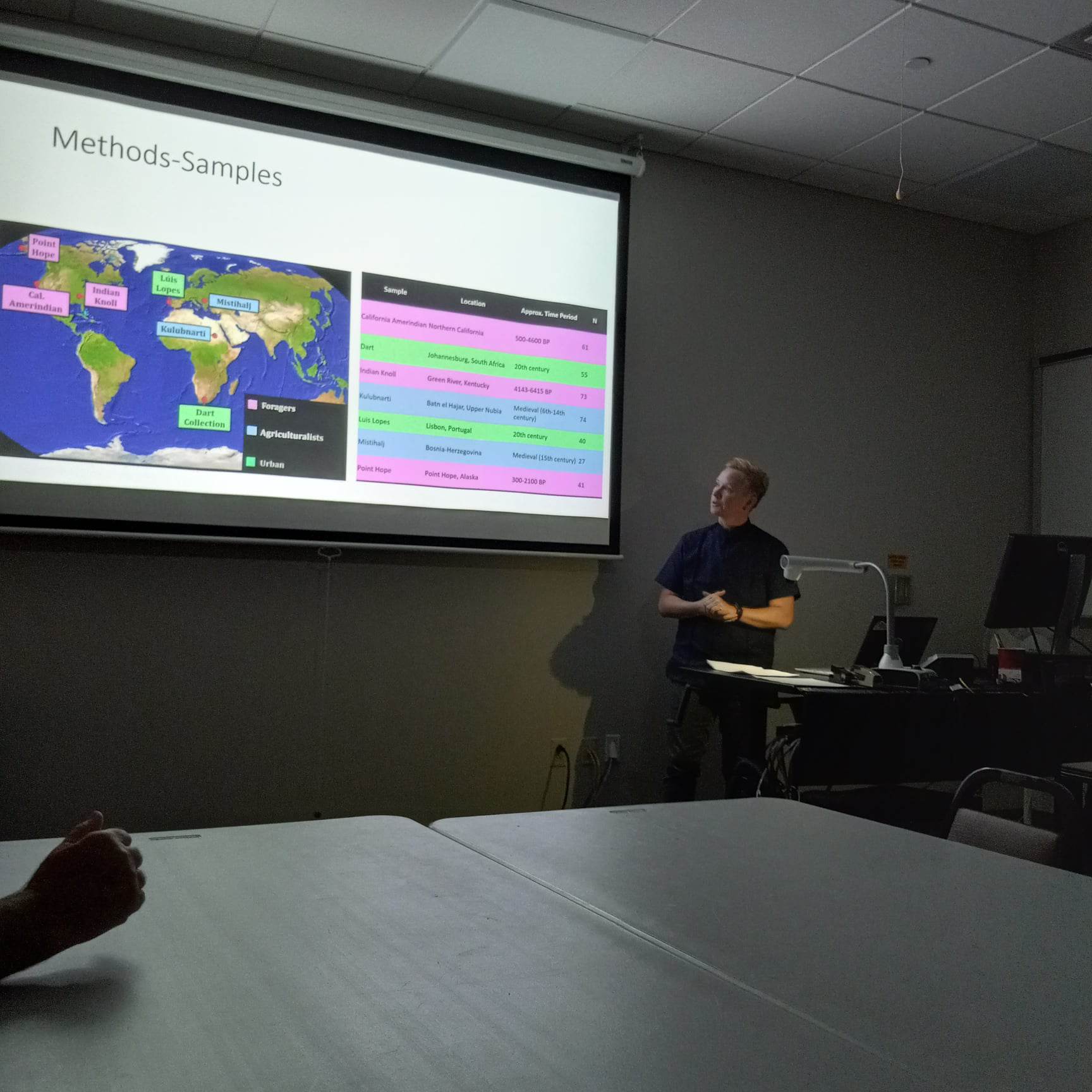
Here’s a pic my mom took at my defense.

White Men, Their White Sons, and the Trampoline Park

It happens like this: your kid is having a birthday party and everyone seems to be enjoying themselves until the one kid who is black comes over to say that this dad told his kid to punch him. So. The kid punched him.

You believe this kid, of course, and ask who the kid is and who the dad is. He can’t find the kid, but he knows the dad; he’s one of the rednecks up in the fucking adult balcony which overlooks the entire place. You know he’s a redneck because he’s hanging out with other white guys who are wearing hunter orange Under Armor hoodies and those stupid fucking t-shirts with the American flag in, like, black and grey with matching hats.

The kid says to you, “You should go say something to him.”

And this is where your privilege becomes glaringly obvious because you realize you’ve never had to have a confrontation like this. So, you try to postpone it. You tell the kid (the 11 year old) you might go say something later. But you really don’t plan on it. I mean, Jesus, you’re 5 feet 5 and 142 pounds. Your hair is purple or red or some color in between and you’re the queerest looking person in the building. The worst part: you know who these fucking guys are. You grew up with them. I mean, maybe you’ve never heard or seen anything too blatant, but you always knew.

So, you look up to that balcony with the redneck dad crew as they survey their land like kings. You tell the kid, you know, “I might go say something later.” And hope the kid forgets about it.

Because you are a coward. And you’re scared of these white dads. And you’ve never really had to do anything like this. Because you are white. And your kids are white.

Towards the end of the birthday party, the kid comes back to you and looks up there, to the balcony of white men, this eleven year old light brown black kid with a poofy pony tail and undercut. And he says, “I’m going to go up there and say something.” And you, a coward, encourage him not to. And say, you know, I want to help you, but I’m scared. And you don’t know what he thinks of you, you fucking coward of a parent. So when he says, “when my mom gets here, she can say something,” you feel like a real piece of shit. You ask, “what does your mom normally say?” He says, “If your kid touches my kid again we’re going to have a problem.”

So, you consult with your partner and your teenage but adult daughter. What do I do? But you fucking know what to do, don’t you? You coward. You white girl type person. You know exactly what needs to happen, but you’re scared. There’s no way in hell you’re letting the kid go up there, but the thought of going up there, ascending all of those steps to where those men lean on their forearms surveying their land, makes you feel nauseous because even though you are a badass, you do not want to be hit or shot by these white men.

Eventually, you puff up and ascend the steps with your daughter behind you because she is ready to fight. She is Gen Z and she gives no fucks and yet all the fucks at once.

So. You walk up the steps and see that he’s coming down the steps, but he’s engaged in conversation with another white man. You wait patiently because you’re socialized as as southern woman, but, sensing a lull in the conversation, you tap him on the arm and say, “Hey, I heard that you told your kid to hit my kid.”

And he looks at you like you’re nothing and says, “I don’t know anything about that.”

“He’s black,” you say, “does that help?”

And with that, this white man starts going down the steps saying things over his shoulder you can barely make out. So you say, loud enough that his other white dad friends can hear, “So, it seems like you do know something about that?”

You let him walk away, but then go to your table where your partner, the kid, and Cyrus are waiting. You’re fucking mad. You call him a coward and he says he has to go to the bathroom and then goes outside.

Why. Why is he going to the parking lot? To get a knife? A gun? Will he wait for you there? You don’t really think so, but you also don’t really know. Now, there are 5 people in your family all wondering what to do.

Just then, he walks back in, so you’re all glaring at him. As he passes he gets mad, “Why are y’all looking at me funny?” And you all answer in different ways, yours being, “I wanted to have a conversation with you.”

But. He can’t handle it. He’s walking away while saying, “that kid hit my kid in the head three times (while playing dodge ball) and, look he’s smiling right now!”

So. You white man. You do know what happened. And you did tell your kid to hit my kid. And you think it’s justified. And you didn’t have the fucking balls to even have a conversation about it.

He still can’t handle this, though. This confrontation and what you and your family look like. (You imagine you’re a white man, momentarily and how the conversation could’ve gone then. Or. The kid he told his kid to hit was white. Would it be the same instructions?)

He keeps walking, back up the steps to his kingdom. And he’s accusing you of arguing, and all you wanted was to have a conversation.

He looks down on you. He flips off the eleven year old. The one black kid. And he’s saying some shit from his tower but you can’t hear him over the roar of children running and jumping and the music.

So, your daughter flips him off. Two hands. And he’s mad now. Saying some shit you can’t hear. But there’s blood rushing in your ears because you’re ready to fight. Or you hate yourself for not doing anything an hour ago.

You apologize to the kid. The kid says, “it’s okay.” And you say, “this is not okay.”

You can see and feel in this kid’s eyes; he’s done this before.

And you, you coward, you almost didn’t say anything at all.

At the Very Least

There is a yearning I have as a queer person to be seen. Not noticed or ogled or stared at the way a person does when my androgyny makes them uncomfortable. Really seen–in the way that you see other people, acknowledge their humanity, and then go about your day. I want to be ignored like the rest of you.

A few months ago, I watched the show “Heartstopper” on Netflix. It’s about two high school boys (who play rugby!) entering into a romantic relationship. When I finished all of the episodes, I was a heap of shivering tears and snot. It wasn’t necessarily because I was happy for them. I mean, yeah, of course I was. It took me some distance and kleenex before I realized that through the entire show, I was just on edge waiting for The Bad Thing to happen. I mean, they get bullied, but they (and others) stand up for them and are ultimately okay. Eventually, they’re both out to everyone in their high school. The last episode, one of the boys came out to his mom. I started crying when he tried to start the conversation. I knew what was going to happen: yelling, tears, accusations, being told he couldn’t live there anymore. But. The mom was totally fine with it. She even told him she loved him and asked questions about the other boy. The Bad Thing never happened, but every time I recognized a possible situation for The Bad Thing, my body reacted to the perceived threat.

That’s when I really fucking lost it.

In my 25 years of being out, I’ve seen movies and shows which portray caricatures, stereotypes, and ultimately, queer people through a heteronormative lens. Ask any gay and they’ll tell you if you’re watching a show with a lesbian she will die at the end, and if she’s dating a bi girl, the girl will leave her for a cis man. There are websites which discuss the trope of “burying your gays” in film and television. When I was first out, I had to search hard to find movies with queer characters. When I did find myself in those films what I saw was me being raped, killed, ostracized, ignored, mocked, and maybe worst of all, utterly unhappy at the end (if I didn’t die in the second act). Queers generally aren’t allowed a happy ending. And our stories are fraught with trauma: getting kicked out of the house, verbal abuse, physical abuse, sexual abuse. Secrets. Lies. Closets.

This entire series of this show I was waiting for the other shoe to drop, for The Bad Thing I’ve grown accustomed to seeing happen to queer people in television happen to these poor, cute little rugby boys. There is a time in the show when their relationship is secret, and the out kid has to be okay with seeing the other closeted kid. I was triggered. Not in the way that assholes use the word, but actually.

To me, being the one who is “out” in the relationship or situationship or whatever, means pain. When I was 21 my girlfriend wasn’t out to her friends. On her birthday, I brought her flowers, and we planned on spending the evening together-painting, watching The Big Lebowski, and drinking Red Stripe. But. Her friends called to tell her they were coming over. She told me I had to leave. At the time I had a shaved head and was wearing men’s tank tops and raggedy, long denim shorts I bought from Value Village. I mean, there was no way I was passing for straight. I should also mention the year was 2000. I pleaded with her to let me stay and just pretend to be her friend. She looked me up and down and said, “they’d know.” I said, “they’ll know about me, but they don’t have to know about you.”

“They’ll know,” she said.

So, she handed me the bouquet of flowers, and I sneaked out the back fire escape from her third floor apartment while they came in through the front.

I’m not lying to you.

In-between my marriage to the Awful One and my other very serious partnership, there was someone. You didn’t know. You couldn’t know. She came from money. And status. And a Baptist family. She went to the best schools. She’d never dated a girl before, but she’d always known, the way all of us know. I promised myself when I was younger that I’d never be with anyone again who wasn’t out. The best laid plans… And. Well. I loved her. And she loved me. But it was all in secret.

One day she flew back from visiting a friend and told me it was over (this was the final time; she’d tried to break it off at least 7 times before that). Because, you know, she just couldn’t anymore. She told me she’d never tell her parents because it would hurt them too much. She’d never tell her friends because it was hard. I was devastated. I mean, utterly gone. I had panic attacks. I became depressed. There was no one to talk to because no one really knew, except the one friend who did know and told me to get a therapist. What still haunts me about that woman is I was merely a ghost passing through her life, and I remain a character who lingers unnamed in her poetry.

This show, though, is utterly joyful. And when I found myself a confused mess at the end, I realized all the trauma that still exists for me. I realized at every turn I expected the worst for these kids because I’d experienced some of it, had heard most of it from friends I’ve met along the way, and I’ve seen the rest reflected back to me on the big screen.

That’s what you’ve seen, too, right? How many happy queer characters exist? How many queer characters do you know where their queerness ISN’T EVEN DISCUSSED because it’s normal and no one cares? When I see something like that, my brain misfires. How many queer characters do you know who do more than just act gay in the show?

As queer people, we have learned to hide. Some of us can shape-shift in circumstances which require it. Some of us don’t have that luxury. Even as someone who has been out for so long, I still find times when I try to make myself smaller to make others more comfortable. I’m still morphing into the person I am–each day moving farther away from who I was told I was, or who I pretended to be. I quit wearing dresses over a decade ago, but finally quit wearing women’s dress shirts when I lost my boobs. Those shirts, and some of the accompanying lady dress pants were a costume I put on so people wouldn’t automatically assume I was “the man.” By becoming who I am, I’m just getting sexier all the time. A lot of queer people in your life are wearing costumes. They are hiding behind clothes, hair, maybe some personality traits that aren’t fully theirs.

As queer people we are raised hearing things like: Don’t be proud of your gayness because it’s embarrassing. Don’t make people uncomfortable by saying it. When someone calls your wife or partner your “friend,” don’t you dare correct them because at least they’re not yelling homophobic slurs at you. At least you’re being tolerated. At least your grandpa isn’t alive to see this.

We are out here, being the least for you. The least likely to say how we’re feeling. The least likely to dress how we want. The least likely to show up to a family dinner because of the looks we get.

The least likely to survive our childhood.

We are the least. Yet, we are told we’re still asking for too much.

42.

I’ve never even read the damn book, but I do know the ultimate answer.

I can’t remember a time I liked my birthday. I’m adopted, so that part always made it feel sad. Today is the day I ruined a teenager’s life. And my parents didn’t get me until I was 5 months old. So. What was this day like 42 years ago? I was born. Some nurse probably smoked a no filter Camel while she swaddled me and watched Guiding Light. I probably spent the night alone in one of those plastic baby bins in the room with the window (though, if I remember correctly, my biological aunts, ages 12 and 14, came to look at me after I was born). Eventually, there was a foster home. Not only did I not have a name, but I’m not quite sure they even got my gender right. My legal name was, “Baby Girl” until Mom and Dad came along.

My birthday also sucks because it’s winter. It’s usually the worst part of winter with grey, slushy snow. When I was 12, I wrote in my journal how sad it was to have a birthday in what I called “the coldest month.” I remember, too, pretending I was trying to survive alone in the snowy woods this time of year. I’d stay outside by the creek behind my house until I was too cold to go on.

It’s not exactly a Christmas birthday, but it’s in the time frame of people still recovering from too much socializing over the holidays. I want to invite everyone to drink with me or do sporty things, but, it’s just usually a bummer outside. Today was an unseasonably warm temperature. But. How was I to know in advance? For the past two years and the pandemic, it’s been a huge bummer inside, too.

My birthday also falls on the first day of the semester for higher ed.

Neat.

I don’t tell people it’s my birthday. Why? It’s not like I did anything miraculous to be born. I did no work whatsoever to arrive in this form on the date and time that I did. There are a lot more things I’d like you to celebrate about me.

But it’s been a rough year. A rough two years. I don’t mind if you know now…now that it’s almost over. I just went through a whole day of work without anyone noticing it was my birthday.

To celebrate, I went to dinner with my family, bowled a little bit, and played some arcade games.

I know what I’m writing is not profound in anyway. I’m just telling you. I’m not even trying to be creative.

Look. I know I’m cool and worthy of all the good things that happen. And, on most days, I celebrate and sing myself.

But. Sometimes you just turn 42. Sometimes you just slip very quietly into a newer, sexier, more middle aged version of yourself.

And that’s just as wonderful as slipping as quietly as I did into this world.

Thirty years later. I’m still playing survivor.

Untitled (is literally the title)

I started watching Seinfeld recently. It debuted when I was only nine, so I just caught a few episodes here and there. Plus, I think we only had one channel at the time and whatever channel it was on, was not the one. The thing is: this show is so dated. The jokes are mostly sexist or related to men and women and all those old tropes. The jokes are also racist. The jokes are also homophobic. I keep watching because I like pop culture. I mean, I want to know the inside jokes of my generation. I want to get it. But. This show is not nostalgic for me. It just plays like an old show.

______________________________________________________

On Saturday, I went to the only official gay bar in town. I haven’t done that in many, many years. I arrived too early because I’m not good at going out. And I like to go to sleep at nine. So, it was 8:30, and I was there with 6 queer dudes and a lady bartender. It wasn’t terrible. People started showing up for karaoke, which started at 9:00.

I saw an old student of mine. Somehow in the conversation we discussed musicals and theatre and musical theatre. You see, when I taught him, I was teaching “Introduction to Theatre.” As we were talking about music and things, he said, “You introduced me to Hedwig. It changed me. And, I introduced so many others to it.” Since I was so moved and unable to express my emotions, I just said, “OMG shut up.” He went on to say that because of me, so many queers were exposed to something they otherwise might not have known.

When that movie came out, I was 21. It blew my mind. Except for Rocky Horror and the trans women I saw at the gay bar in Houston (though we did not say trans and we did not openly discuss women like this), this was one of my first exposures to, well, differently gendered people. The musical made a huge impact on me.

Of course, 20 years later, I can see how it can be problematic. Is Hedwig a trans woman or a gay man who gave up “a piece of oneself” in order to escape East Berlin?

_______________________________

The episode of Seinfeld I’m watching right now is called, “The Subway.” One of the sub stories is that Elaine is going to a “lesbian wedding.” Costanza asks at the diner, “so who is the groom or the bride? Do they just flip a coin?” Elaine responds sarcastically, but there is no more dialogue about it. At the moment I started writing this, she was on the subway getting into a conversation with and older woman. Elaine says the present she’s holding is for a wedding. The older woman asks too many questions and Elaine finally says, “there is no man. It’s a lesbian wedding and I’m the best man.” The older woman scoffs and then moves away from Elaine. Elaine calls after her, “Wait! I’m not a lesbian! I hate men, but I’m not a lesbian!”

_______________________________

So, while I’m at the bar talking to my student I ask him if he likes boys. He says he does, but he also likes girls. I say, you know, it just doesn’t matter these days and that’s awesome. I’m positive that me asking this personal question made him feel comfortable to ask me, “are you going by different pronouns now?” I laughed and said no. And pointed to my chest. I had cancer, I tell him, so, I don’t have those anymore. He says I look great. He says I look younger than when I taught him. That was about eight years ago, I figure. I weighed maybe 15 pounds more. I was sadder then, too. I tell him I’m a girl, but that I don’t really care anymore. My gender is not important. I’ve been saying that a lot recently. I had a conversation with a friend the other day about this. He is a boy. I am maybe a girl. We dress the same. We walk and talk the same. I tell him, you know, I don’t know if I’m a girl, but I do know that I’m not a boy. He says the same for him. He doesn’t know, but he knows he’s not a girl.

It doesn’t matter. I mean, it doesn’t matter to people who belong in your life. It does matter to those other people, though. You know who I’m talking about.

_______________________________

I’ve been gender bending for a long time whether I meant to or not. I’ve been kicked out of and stared at long and hard in bathrooms. I had a shaved head 25 pounds ago and wore baggy pants. Now I have short hair, wear “boy” clothes, and don’t have boobs. In fact, the other day, an older man opened the door for me and while I was saying thank you, I saw his eyes move up and down my body. I could see that he was questioning his decision about if he should’ve opened the door or not. I laughed behind my pandemic mask. On another occasion recently, I felt someone coming up behind me. I hear, “excuse me……..” I knew the long pause was meant for my gender. He couldn’t decide on sir or ma’am. It didn’t bother him, though. You can just tell these things. I helped him find his way across campus.

______________________________

Toward the end of my night out, as a friend and I were heading home, some queer man stopped me to ask my name. I told him, “Christina.” He said he hadn’t seen me there before. I said I don’t really go out much these days. And then I said, “Well, I’m an old Soco gal. I went there a lot around 2002.” He looked at me, paused, and said, “Gal…so you’re not a gal now?” I laughed, “I’m still a gal.” But then this guy looks blatantly at my chest and says, “Sorry. It’s just that you don’t have any boobs.”

When anyone says the word “boob” to me or I say the word in reference to the parts of my body that were, I always sort of swipe my hand into the void of where they were. I said, “I had cancer.” He tripped over some words or some syllables and I saw his friend behind him and the embarrassment on his face that he felt for his friend’s mistake. The behind friend said, “congratulations on your survival” or something equally as awkward. I said goodnight.

And I thought about that interaction on the way home.

____________________________________

Remember my friend who dresses like me? The one who’s anything but a girl? There have been several occasions when he and I are hanging out and servers at restaurants assume we’re together. I mean, really together. I’ve noticed, though, these servers are, like, 21 at the most. I’ve never been so happy to be mistakenly someone’s love interest. Here we are, two very queer looking people. And these young servers aren’t assuming I’m a big ‘ole dyke. Because, you know why? They really don’t care. They have seen all sorts of people with all other sorts of people.

I think back to my 21 year old self. Christina at that age wanted to be seen as a lesbian. She wanted people to recognize she was a woman who was romantically and sexually interested in other women. It felt good. I felt like I was doing my part to be seen and have others be seen.

Christina at 41 is much different. I don’t care if you can’t figure out my gender. Hell, half the time I can’t either. I don’t care if you think I’m sleeping with my much younger dude-ish friend.

I’ve said a few times recently that if I would’ve “known” about non binary people when I was a kid, I probably would identify that way. Or genderqueer. Or anything other than woman that isn’t “man.”

Isn’t it ridiculous to believe there are only men and women and they can only have sex with each other and only one person until they die? It’s utter insanity.

I mean, I’ve asked this before, and no one has really answered, but, what does it mean to be a woman? What does it mean to be a man? I honestly can’t tell you. I just know that I’m probably neither.

_______________________________

I call myself queer now because it’s a reclaimed word and it encompasses everything about me: my sexuality, my gender identity, my androgynous appearance. I am queer just means, I’m not about that 2 gender 1 sexuality type thing that this society seems to be so fond of.

I know I’ve said it a million times, but I wish we didn’t have to talk about this. I wish people could just say their pronouns, people would say, “nice to meet you,” and we’d all just fucking move on with our lives. But. We can’t.

It’s still important that queer people speak up and that we are seen and that we have allies who help us when we’re too tired to do all of this work.

But saying, “I don’t care who you sleep with, as long as you don’t flaunt it” is sort of like saying, “I don’t see color.” It’s important to see and acknowledge black people and their experiences. And on this, Indigenous People’s day, it’s important to see and acknowledge the indigenous people whose ancestors lived here long before most of us. I want to be clear that I’m not equating being queer with being a racial minority; I want only to say that we must still, because of our past, acknowledge the struggles that others endure.

______________________________

If you’re wondering about the Seinfeld episode, well, Elaine gets stuck on the subway and misses the wedding. She has to, I guess, since the whole episode is about the four friends and their separate, but comical misadventures on the subway. But, the three male characters have fuller story lines in this episode. And it was 1991. I was 11. That’s how old Cyrus is now. I probably didn’t know the word “lesbian.” I would’ve gathered, however, that lesbians are different and bad and something to laugh about. I mean, I learned that eventually. Somehow, though no one ever said it directly to me, I knew. The same way you learned. That we’ve all been taught. Somehow.

___________________________

Here ends this year’s “coming out” post. Maybe you’re wondering, did Christina come out as non-binary?” What is she saying? Is it still she? What do I call her? I mean they!??

Let me make your anxiety even worse: I don’t know. I don’t care. Who fucking knows. It doesn’t matter. Probably still she.

And, call me whatever you want, just don’t call me late for dinner.

ba-dum ching

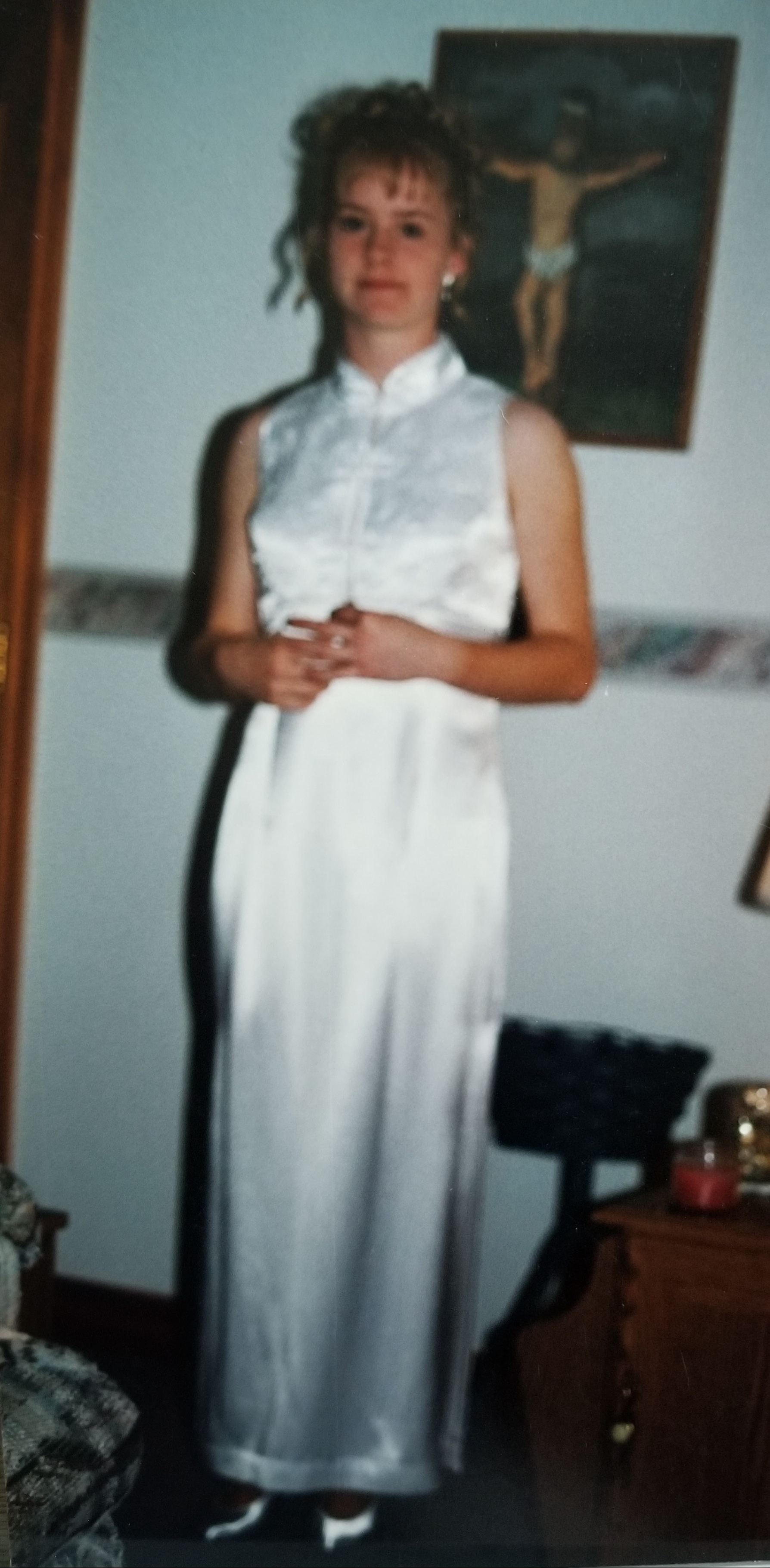
Just look how comfortable I was in this dress when I was 15 and Jesus looking over my shoulder.

Venmo: @molepoet

Photo Bomb

There’s something that’s been on my mind since it happened to me on Saturday:

I was at my hometown bar when someone I know but don’t really know started telling me about her cousin ( a girl) and her girlfriend. I didn’t ask, by the way, but I sat and listened as she shouted over the music that they live in another state and the girlfriend is a real bitch and do I want to see a picture of her cousin? I don’t care, so I say, “uhhh.” But, it’s too late. She’s scrolled to a picture of this girl. She awaits my response. So, I say, “okay.”

Maybe thirty minutes later I’m dancing with Cyrus and I see my mom trying to take a picture. I can see that it’s not her phone, but I don’t think a lot about it. Of course, I just flip her off because I am me.

Not too long after, I’m talking with my aunt, and I turn to say something to Cyrus. I see this massive phone right in my face, held by the person I know but don’t know. I say, “what the fuck are you doing?” She says, “I’m taking your picture.” Rudely, I ask, “why!?” And she says, “Don’t be hateful. I just want a picture of you.” Again I ask why. This time, she instructs me to stand up, smile, and she takes a selfie.

Queer people: You KNOW what this was about and why it bothers me.

NOT queer people: You can sit with this one and think on it until you find the answer.

Just a few weeks ago, I had to explain to someone I’ve known for many years what a micro-aggression is after this person revealed that they aren’t really an ally and can’t decide if they want to be. No. I didn’t have to explain. I chose to. I chose, once again in my fucking life, to educate someone.

I have been an out queer now for 24 years. The first year, I was out in Callaway County, Missouri. I think (correct me if I’m wrong) I was the first queer person to come out in my high school. You’ve all read or heard about that year by now, so I won’t repeat it. It was bad.

But, at the time, I had a very special thing going for me: Youth. I was excited to discover gayness and learn all the terms and wear rainbows and pink triangles. I was happy to have found that I wasn’t alone. I had the time to explain to you that, no, no one is “the man” in the relationship. I was so hopeful, friends, that because I was so blessed to be from such a small community, everyone would realize I was still just the same person they loved previously. That wasn’t the case.

It’s still not the case.

After 24 years of explaining to you and you and you that I am just a human person like everyone else, I am exhausted. I can no longer expend this energy to help you understand. It’s not really my job in the first place.

This photo incident got me really worked up. The thing is, I’ve been me for so long, I no longer think about how I look or how others look at me. I have short hair, I don’t wear dresses, and now I don’t have any boobs. I’m androgynous as fuck. And I look good. And I forget that people out there might be somehow upset or excited by this….this non-gendered expression. Some people, with large phones, might even see me as a spectacle…one they can just secretly photograph.

As I’ve been relaying this Photo Incident story to friends, one queer friend asked, “are there really people out there who’ve never considered their gender and sexuality?” And, I bet some of you reading this haven’t. You haven’t needed to in order to justify your own existence. You’ve never had to convince people that your relationship is just as valid as theirs. That your intimate relationships are not their business just like theirs aren’t yours. What a privilege to never have anyone ask you intrusive questions about your sex life, to assume things about how you feel toward your partners, and for someone to feel totally comfortable asking you about what parts you do and do not have.

There are an infinite number of genders and sexualities and ways to have intimate relationships with other age-appropriate human beings.

I once posted a meme that said, “to choose to be visually queer is to choose your happiness over your safety.”

Today I said to two “straight passing” queer friends, “my androgyny is a burden on me.” People see me and make a lot of assumptions about who I am. And they base their interactions on those assumptions. If I wanted to, I could grow my hair, swish my hips, and learn to contour my make-up. Boom. I’m not queer-looking. And maybe people would treat me differently.

-Of course, when I write about these things, I’m never just talking about the LGBTQIA+ community, I’m talking about other minorities, too. Those who face different prejudices and have been forced to educate others since the day they were born.-

I come out to someone, somehow, every single day of my life. I live in a world built for cisgender straight people for cisgender straight people, which means I’m bombarded by micro-aggressions every single day. Sometimes, a Jeep full of frat boys call me a fag as they speed by me. Sometimes, people refer to my very serious partner of many, many years as my “friend.”

And sometimes, well, they just want me to shut-up and hold still so they can take my picture.

Venmo: @molepoet

You Can Never Go Home Again: Part II

This whole story isn’t really about being queer. My life isn’t supposed to be about being queer the same way yours isn’t meant to be about your romantic and sexual relationships. That’s not who you are in your core. You don’t “identify” as straight. You don’t describe yourself that way. I don’t want to describe myself by my relationships, either. But I have to. Time and again. Why? Because it matters to cis-gender straight people for some strange reason.

I moved to Houston sometime in late summer of 1998 after I graduated high school. Why Houston? Because my girlfriend, an educated, polite, and successful Texan happened to be from there. (The story of how we met is detailed in the coming out anthology if you want to read it some time. It’s romantic as hell and even includes writing letters and making mixtapes featuring The Cure, Depeche Mode, and George Strait.) I had plans of softball scholarships and Mizzou, but I secretly applied to the University of Houston and made my escape.

The shock of going from a quiet town along a river to a huge, stinky city near the gulf was immense. I could read a map, but I’d never driven anywhere larger than Columbia. I didn’t really know how to cook or wash my clothes. I didn’t know what raves were. Until I did. I hated cilantro and avocado and I’d never had Indian food. I went to class and came home to the house we shared with my girlfriend’s best friend. I was a terrible roommate. I don’t think I cleaned once. I’m sorry to both of you. After a few months I felt myself slip away; I realized I’d never been where no one knew me. Around my part of the world it was always, “Aren’t you that Holzhauser girl?” The anonymity of the city helped teach me I wasn’t as special as my parents had led me to believe. It was a tough lesson to learn, but it was also a huge relief. I had to remind myself constantly that was a big reason I had to leave.

Being queer isn’t a lifestyle. It’s not like subsistence fishing. It’s not deciding to live in a van and travel the U.S. like Steinbeck. I did a lot of queer things in Houston, though. I had a friend who sneaked me into “the gay bar.” (It was called “Chances” or “The Barn”) There were plenty of gay bars, but only one I ever really went to. It was divided into three areas: The front was a classic American diner where the trans ladies and drag queens hung out. The middle was what we called, “prom.” That was the area for dancing to Madonna or whatever was new. Then, in the back, that was where you could two-step. I went other places, too. Rich’s was a men’s bar that looked like something from all of those films I watched about cities. There were almost-naked men everywhere. Some wore make-up. Some wore mesh shirts. Some danced in cages. All of them smiled at me in a way that told me I could belong and not belong at the same time.

No one tells you how uncomfortable it is to watch so many same sex couples and other queers dance and kiss like straight people. When you’ve never seen it, even if you’re one of them, it’s disorienting. And I’m not talking about gross stuff. I’m just talking about people acting like people do when they’re out on a Saturday. I was embarrassed that I had to get used to it. In my world, there were no queer people in movies or in tv shows. I wasn’t used to seeing myself anywhere other than my own mirror.

I was taken to a pride parade without understanding the concept. I mean, when you’re queer, no one teaches you history or anything, they just expect you to know or figure it out. So, there I was, walking down the sidewalk taking in the parade, when some dudes are walking backwards, holding signs and chanting, “God hates fags!” They accidentally bump into me. One dude turns around, you know, instinctively, and apologizes sincerely. I look at him for a moment as he looks at me in a white tank top, baggy men’s jeans, and Birkenstocks, my chain wallet glistening in the sunlight. I say nothing as I wait for him to see the irony of what’s just transpired.

I shaved my head and dressed more masculine. Then, I grew out my hair and tried out leather pants and no bra. I learned to drink Shiner Bock and Lonestar while I danced with older women who’d bought them for me. I learned to play rugby, what an arthouse theatre was, where to go around the city, how to drive anywhere, how to shut up with my former judgmental shit and learn about new people. I learned how to live in a city. I got so good that no one who met me would guess where I came from. By looking at me, you’d think I was some sort of rave kid or alternative street kid.

I lived in the queer part of town. Westheimer. People were very weird there, so I was nothing. I didn’t stick out. No one gave me the looks. I blended in and found my people at the job I worked which was an outdoor/camping supply store in the area. This is where I unlearned all of the prejudices I’d amassed growing up and where I became cultured. I was schooled in music: Tito Puente, Bob Marley, and Shakira. I learned what vegans and vegetarians were. Oh, the food I learned and learned to eat! I learned that abortion isn’t the murdering of babies. That not all brown people are from Mexico. That not everyone grows up eating squirrel. And, I was shocked to find out that not everyone was Christian. I learned that people can be bad. That people can be very, very wonderful and accepting. I learned there that I was not alone. That we are all different and the same. I grew and grew into myself.

More and more frequently I found myself in spaces where my whiteness was the minority, and sometimes unwelcome. Some huge and very bright light bulbs started flashing above my head.

In that growth and that swarming mass of beautiful and strange people, I started to see my hometown as an awful, backward place. Only white Christians lived there. Only straight people lived there. I had to consider all of the racist shit I’d heard growing up. Did I remember correctly that my relatives said these things? There was a whirlpool of bigotry that my younger self felt but couldn’t name. Most people there had never really left. Had they tried to? Were they stuck there? I felt like I was the only one who knew I had the choice to leave.

Not many people from my family reached out to me the four years I lived in Houston. I mean, of course my parents did, and I even made trips home for holiday gatherings. At the time, my relationship with my parents was still very strained, but they were getting better. The distance helped, of course. Only one aunt sent me a letter. I can’t remember what it said, exactly, but it was something along the lines of “I don’t understand your lifestyle, but I still love you.” As a 19 year old, it pissed me off. Now I see it was an attempt at reaching out, maybe apologizing. I still carry the guilt of not responding to that letter.

At that time, I was ashamed of where I’d grown up. I was embarrassed to be so ignorant. I felt deprived of a life I could’ve had if only I’d been raised in an urban place.

The first panic attack I ever had was at an Indian restaurant after I bit into a samosa. The flavor was too much, too unfamiliar. There were so many people in the restaurant and so many cars whizzing by. And my new girlfriend who couldn’t figure out why I’d freak out over such a delicious place to eat. I had to leave. I wanted to be by myself. But in a city that large, it was impossible. I tried to think of a place to go. I pictured parks with trees-full of people. Museums-full of people. There was no where. So, I sat and cried in my basement efficiency apartment.

Each night when I tried to sleep, with all of the sirens blaring, and cars with their vibrating trunks and Tejano music, the occasional screams, the upstairs neighbors stomping about, I put a pillow over my head and tried to think of home. I just needed one night of peace, of an open window and cool breeze. Of frogs and cicadas. Just one day in the woods alone to quiet my thoughts.

My only options for an existence seemed to be to stay in the city that was wonderfully ambivalent toward me but was constantly noisy and busy, or go home to the peace of my river where people stared through me and talked about me behind my back. Back to the country where people had opinions about groups of people they’d never even met. Back to a place that no one could seem to leave.

Portland, my hometown, was suffocating though I could get lost in the woods. Houston taught me how to feel alone without ever letting me be alone.

I was 22 when I felt like I knew too much and not enough. I felt like I didn’t belong anywhere.

For the first time in my life, I felt like an orphan.

Age 21. Somewhere in Texas Hill Country.

Venmo: @molepoet