My White Son

It happened on Saturday,  somewhere between first and second base, the top of the second inning. I peered out among Cyrus’ t-ball team and realized he was the only white boy. I looked out among those tiny hats and tiny cleats, among the six year olds. And I saw another coach on our team: a black man. And I saw his beautiful black son, with his six year old sized ball pants, his genuine smile and love of the game. I saw a small black child and realized that child would grow up to be a black man. I looked at his dad again. I started to cry. I wondered what this man would have to teach his son that I would never have to teach mine. I wondered at what it meant to raise a black man in this country.

And then I thought, for the first time, of my own responsibility; I have a white man to raise. At what age do these two teammates become something other than just children?

  *    *   *

My parents tell a story of when I was about three years old. One night they decided to open a magazine and start pointing to people and naming them. I vaguely remember this night. They pointed to white people. They pointed to black people. They pointed to Asian people. Not too long after, we found ourselves in KFC. A couple walked in with a kid. I jumped up, stuck my head over the booth, pointed, and screamed, “Black baby!”

When they tell this story, they recall the extreme embarrassment. When I ask why they decided to show me the magazine, they can never quite remember the reason. I suppose, growing up in such an isolated community, they wanted me to know that there were more people in the world, people who didn’t necessarily look like me. That couple was quite possibly the first black people I ever saw.

 *   *   *

Cyrus has never been shown the magazine, so to speak. I don’t have any plans to point at people and give them names. I am lucky that he hasn’t grown up in a tiny, conservative white town. His friends and classmates come from everywhere and are sometimes differently-abled.

This doesn’t mean that I’m naively saying, “I don’t see color.” I see color and racism everywhere, since I grew up around it.  I want him to have a deep understanding of this country’s history. I want him to acknowledge his own privilege. I want him to speak out. I want him to do good. I want him to be good.

In order to do that, I have to make sure I’m setting a good example. I know it is my responsibility to be active in the community. I know it is my responsibility to listen. I know it is my responsibility to speak up, when it is my turn.

Now it might be my turn.

White people: You have seen and heard a million racist things in your lifetime already. You know it happens. You know you’ve been complicit in it by turning your back or laughing. How can you possibly think that this racism hasn’t touched every aspect of the lives of non white people in this country? Shut.the.fuck.up. And listen to people of color. Really fucking listen to the narratives of your friends, neighbors, and, most likely, strangers. People are dying just for being. Do the right thing. Your children are watching.

People of Color: I see you. I hear you. I’m listening to everything. I’m angry. Really fucking angry. I am, at the same time, paralyzed and more motivated than ever. I acknowledge my privilege. I vow to do my best to make this world a better place for all of our kids.

I am raising a straight white man. And I am scared as hell.


ball


End of (School) Days

There is something beautiful about being in an empty classroom; on the first day of school it’s the symbol of all the possibilities. It’s the beginning of new discoveries for both a teacher and her students. It’s the anticipation of what characters and ideas will be shared in the weeks to come.

I became a teacher accidentally. When I applied to graduate school, I learned that teaching is what grad students typically do. Of course, for students of creative writing, it’s very rare that we’re afforded the opportunity to teach what we’re interested in. Usually, we, like any other grad student of English, teach composition. If you don’t know, composition is what most people would consider the opposite of creative writing: there is specific structure, grading rubrics, assignments which ask students to illustrate, research, and persuade an audience (not that this doesn’t and can’t happen in creative writing). It is not poetry. It is prose which can sometimes take the shape of narrative, but generally requires students to learn about reputable sources, ways of researching, proper formatting of essays, and incorporating others’ ideas into their own writing. It’s not naturally fun. It’s a required course. It’s a classroom of 18 year olds learning how to college correctly. For the student, it feels like busy work and too much writing. For the teacher, it feels like being suffocated under a stack of papers while trying to explain that there are rules for comma usage and no, you can’t just write it the night before it’s due.

A lot of times, it feels like parenting.

Somehow the academy thinks it’s my job to teach them life and college skills. Professors in other departments think it’s my job to teach them how to be amazing writers in just one semester. In fact, we are blamed by universities if the students don’t write well when they get out of our courses.

Here’s what I teach:

1. Don’t email your professor and say, “Hey…”

2. Things have to be turned in on time

3. It’s rude to come to class late

4. Yes, it has to be turned in on time

5. Put the phone away.

6. Classical argument structure

7. MLA formatting (which they can google, but still fail to do correctly)

8. Close reading of texts

9. How to play rugby

10. How to have a meaningful discussion about literature

11. Where the library is

12. How to use a library

13. Yes, you have to go to the library and touch and read an actual book

And though you’ve probably heard me complain before about the awful papers, the hilarious sentences, begging for grades, the way they try to email things to me days after they’re due–I do love teaching. I love meeting new people. I love helping students understand new concepts. I’m touched when I see an evaluation that says, “I always hated English until I took this class.”  Or “Christina really cared if I was learning.” That’s what it’s all about.

I love teaching. But teaching hasn’t loved me, exactly.

As a full time professor, there is more to teaching than just teaching. There is committee work, advising, curriculum redesign, hiring committees, class planning, GRADING, and, for some, their own research and grant writing. The teaching part of teaching is about 5% of how professors spend their time. Maybe less. I have been in that position. I taught as a real, full time professor for three years. Quickly, I realized the school didn’t quite care as much about the students as I thought. It was more about the numbers and money. I no longer wanted to be a part of that culture. So I left.

I’ve been teaching as an adjunct since then (and have held 8 other jobs in those two years). There is a lot less commitment to the university and more to the students. But there is still the planning and grading. When someone adjuncts in this part of the country, the pay is about 9 dollars an hour.

Yes. Some adjuncts earn less than minimum wage.

There are a lot of stories like mine. I have worked my ass off teaching for 9 years here in mid-Missouri. And somehow, I ended up where I started.

I tell you all of this because I think it’s important you are aware of what happens to most teachers you know. We burn out quickly and brightly.

Besides being a symbol of new possibility, an empty classroom can also mean relief. Finally, a break from grading, from poorly written emails, from excuses about late work.

Today was my last class for the semester.

Or.

Today was my last class.

Due to budget cuts and low enrollment, I don’t have a job at Mizzou after this semester. I was offered a job to teach two classes at William Woods (8$ an hour to what is basically 20 hours a week). Starting again in August. I don’t think it takes a degree in math to understand why that simply cannot happen.

I didn’t quite realize today was my last day until right before I walked into the classroom. I’ve been so busy with applying to jobs and trying to catch up on grading and laundry that I hadn’t taken the time to think. I brought my students candy and we talked about their final projects and due dates. I’d told them all my struggles of job searching and job finding. I’m open with my students. I show them that teachers are humans, too. One student realized what today was and said, “This is your last day teaching…forever.”

I’ve been teaching now for 11 years. If I’ve done the math correctly, I’ve had 900 students in my classroom. Which means I’ve read 4,500 essays. Which means I’ve commented on 13,500 pages.


I start my new job as a Research Specialist on May 9th. My new job has nothing to do with creative writing, teaching, or English. It does have everything to do with anthropology, skeletons, data, relearning what I once knew, and having two bosses to monitor my work. It is only 40 hours a week. With vacation, sick time, a salary, and insurance. It does not require that I grade papers while I’m waiting at Jiffy Lube, while I’m eating breakfast, while Cyrus is occupied with his Bat Cave, while I’m visiting my parents, while I’m on vacation, or when I’m in the bathroom. I am looking forward to coming home and not having a stack of work with me.

Today was my last class, though there is still a lot of grading to be done.

After the last student left, I paused and looked out into rows of empty chairs still warm from bodies. For four months, they sat there while I talked. They sat in my class for 11 years. Where I was in charge and finally knew what I was doing. Where I could make my own rules. 

Today the empty chairs did not feel like relief; they did not feel like a fresh start.

When I walked out today, I turned one last time to look at those chairs, my classroom. It did not just feel empty, but completely abandoned.


last day mu

Girls on Film

When I was 17, I started working at Broadway Video in Fulton, Missouri. (“Thank you for calling Broadway Video where the hits are here, now, guaranteed, this is Christina, how may I help you?”)  I had to ask my parents first, since it was 30 miles from home and the closing time was around 11:00 p.m. It was 1996, so everything was still on VHS. I spent hours putting tapes into the rewinder and charging people a fee because they couldn’t do it their damn selves.  I worked with Kristin, one of my best friends, so we spent our time gossiping and choosing movies to put into the VCR when no one was in the store. She memorized the Men in Black dance and loved to do it when no one was around. When she wasn’t there, I challenged myself to close my eyes and picture where every single film belonged. Sometimes I’d just spin move my head back and forth, try to orient myself, and open my eyes to see if I knew exactly where I was looking. It was usually Lost Highway or Midnight in the Garden of Good and Evil. To the left of the check out counter were the new hits, mixed in with newer indie films. Of course, being from Portland, I had no idea what an indie film was, but Kenny, another guy who worked there was starting to show me.

One of the first ones on the shelf was All Over Me. I was allowed to check out movies for free, and really, the boss said, I could just take them and bring them back without putting them into the computer.

220px-AllOverMeIndieFilm

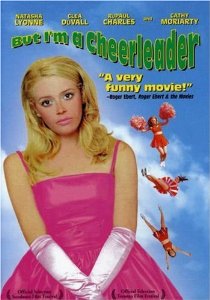
I chose this title one night, after a long day of rewinding because it looked like one of those indie films I’d heard about. I took it home and popped it into the VCR around midnight. I sat in the living room and watched as some girl with pink hair played guitar. And, at one point, she kissed another girl. In another mind blowing scene, I watched as one licked the other’s stomach. I couldn’t believe what I was seeing. I mean, I’d seen two girls kiss just a year before in this film:

download

And why do these two film covers look the same?

Which a friend had recorded from HBO and given to me to watch. I didn’t know why she did. But I came to understand as we aged. (If you’ve seen this film, you know there is some violent sex, rape, and very awful situations, but my focus remained on the girls kissing in the pool)

But this pink haired girl had me very confused. I stayed up all night, rewinding the kiss, the tongue to stomach action, worried that my parents would wake up and find me watching it. I didn’t quite know why it was wrong. I mean, there was no sex in the movie All Over Me, just some kissing and stomach licking. But it seemed dirty. Like I wasn’t supposed to see it. So I watched it in darkness that night and probably 20 more nights as I’d return the movie to the store and sneak it out again, sometimes in a different case.

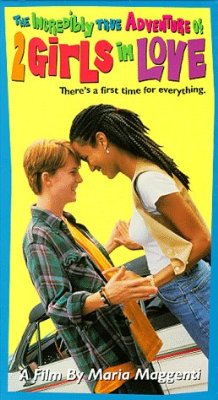
Not long after that I met a girl. My world started spinning uncontrollably and, to make it worse and more confusing, this movie was on HBO that whole summer:

True_Adventures_of_2_girls_1995

I watched it, disgusted. Confused. In silence. I cried. I prayed. I wished I could be someone else. And you know what happened after that.


Tonight when I was with some of my rugby friends we started talking about lesbian films. There aren’t that many, so it’s common for lesbians of any age to know most of them. We were in mixed company, though. There were 4 girls who date boys and 3 girls who date girls sitting at the table. The girls who date boys had never heard of any of these films. Meanwhile, we laughed and joked about all that we’d seen. How it seems that any movie with a lesbian lead means she’ll a) kill someone b) kill herself c) turn straight at the end. It’s hard to find films about lesbians that have happy endings.

The straight girls wondered how they missed seeing all these films since the rest of us had seen them. But. I tried to explain, we had to seek them out. To find ourselves mirrored somehow in society. I remember discussing titles with my worldly co-workers in Houston, trying to memorize all that they’d said so I could find and watch all of them. I felt like I was in a secret club.

One of my teammates, who is at least 10 years younger than I, said she used YouTube to watch most of her movies, clip by clip.

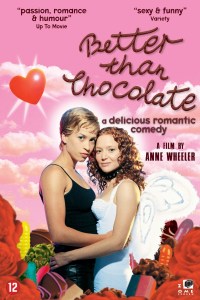
I shared that I was lucky to be exposed to a video store and then moved to Houston, met liberal people, worked next to a video store, and had movies like

51jPNnIqJ1L._SY300_

come out in the art house theatres. So it was from there that I learned about

download (1)

Claire-of-the-Moon

and

download (2)

and I also saw

poster-12088

in the theatre.

I wanted to explain to my everyone at the table how  important it was for me to see myself on a television, to see two girls kiss in some larger narrative (instead of at the gay bar). In my day, there was barely an internet and Ellen was still newly gay. No one even talked about gay marriage. I know some of you must know how this feels– to want to see yourself on a screen. Ultimately, though, I think most people have never yearned for it because it was never missing from their lives. They see themselves in every movie, terrible sit-com, and perfume ad. Every single day.

I, however, see myself (or people meant to represent me) in very few films. One commercial with Abby Wambach. Ellen is on every day now. I still can’t believe how many straight women love her show.

I see misrepresentations of myself everywhere, though. I see people like me being denied marriage licenses, being denied cakes, jobs, and a pot to piss in. I am reminded daily by advertising and movie previews that I am not like everyone else. I have watched for half of my life as politicians and other people make decisions about what I can and cannot do.

And I’ve grown so used to it that I forget to talk about it with others who might feel the same way.

Tonight’s conversation felt so good.

At the end of the table were two teammates quietly mocking us, “So, when did you realize you were straight? Do you think your parents made you that way?” I don’t think they meant it in a mean way, but what I took away was this: they felt left out of the conversation.

That must feel awful.


Pants Envy

Tonight I took Cyrus to get fitted for a suit; he’s the ring bearer in my cousin’s wedding in a few months. There were so many cool vests and shoes. Two tables of a rainbow assortment of ties. The man who helped us had on a bow tie and shoes I wanted on my own feet. We also happened to have the same haircut. Was I attracted to him or did I just want to dress like him? I struggle with this sometimes.

I’ve always felt comfortable and uncomfortable in the men’s section of stores. If you know me, you’ve noticed I tend to wear men’s shorts, sometimes jeans. Women’s shorts are always way too short or full of weird ass-pocket designs. Except when I had blue hair and combat boots, I’ve dressed functionally. I wear band t-shirts most of the time, though I’ve purchased a few women’s sweaters and t’s in recent years. Women’s shirts seem too thin or cleavagey. I sometimes have trouble fitting my broad shoulders, too. But there’s something unsettling about shopping in the boy section when you’re a queer woman like myself; I become incredibly self-conscious. I feel like everyone is looking at me and judging. Like everyone is making assumptions about who I am, what I like, how I have sex. This is one of the big reasons I hate shopping. I do most online. If someone from across the country is judging me as she packs my box of clothes, fine, at least she’s not eyeballing me over a rack of  men’s sweaters.

Wearing men’s pants doesn’t mean I’m a man or that I want to be one. Who I am and what body I was born into are both fine with me. This also doesn’t mean that all lesbians dress the same, either. Please do not start assuming those things. It also doesn’t mean that I think every woman should dress like me. Sexuality and my gender are two separate things. There are straight women out there who also don’t feel comfortable in dresses. Wear what makes you feel like yourself. That is all we can do.


When I was in Kindergarten, Mom put me in sun dresses for school. Since it was 1985, those dresses came with yellow, flowery, ruffly bloomers. Sometime during the day I’d go to the bathroom and tuck my dress into my bloomers, you know, because they were more like shorts. I’d get off the bus and Mom would be waiting for me with some look of horror and amusement. I didn’t care. I felt so much better.

Of course, as I grew and was forced to dress up for events, I started wearing pants whenever I could, fighting with Mom about when it was okay and when it wasn’t. Proms were an awful time, too, trying to figure out what kind of dress was okay and cool for me to wear. I was never excited about picking out a prom dress.  For high school graduation, I was told girls had to wear dresses and guys could wear pants. Total bullshit, obviously, so I just put on some boxers and a tank top under my gown and threw on some heels (to be discussed later). It was my final fuck you to the principal who glared at me any time we met in the halls.

When I teach, I sometimes wear ties or bow-ties. But always pants and a button-down shirt. That’s how I dress up.

But really, I honestly always try to picture myself in survival situations. If suddenly the zombie apocalypse happened and I was stuck in a fucking dress and heels, how could I possibly survive? If a tornado ripped through and I had to dig for my loved ones among the wreckage, what use would I be if I weren’t wearing pants? If I were on a plane in a skirt, and it crashed, what hope would I have of making it more than a week in that climate?

There have been time when I’ve felt sexy in a dress, though. For a friend’s wedding, I had to buy a black dress. I complained, but I enjoyed it. I felt good in it because I got to choose it. I even grew my hair because I wanted to. It’s fun to play with gender sometimes, isn’t it?

But usually I don’t like dresses. It’s more than that, though. It’s the way I feel when I’m in one. I feel like I’m in drag, mostly because of the attitude people have when they see me in one. People laugh. Or they feel just fine commenting on my body. It’s the same, but less, during the few times a year when I decide to wear make-up. “OHMYGOD are you wearing mascara!? Ooooh.”  These reactions, I’ll have you know, mean I’ll wear it less and less. Because. In middle school my friends thought it was fun and funny to dress me up. Haha. Christina’s in a dress. She looks hilarious.

You might as well put a costume on your cat.

When I wear a dress, it’s not just funny Christina in a dress; it forces me to change who I am. I can’t sit like I usually do, with my legs spread. I have to walk differently, too,  in order not to look like a dude in a dress. I’m more aware of how and how much I move my body, like my arms, when I’m speaking. I can’t wrap my arms around the back of chairs and give sideways smiles. I have to sit straight with my legs crossed. I have no idea how to do this. And all of this change directly affects how I act. I become quiet and people ask if I’m okay because I’m not acting normal. Of course when you wear a dress, there’s going to be some shoe that’s too narrow and has a heel. Maybe it’s only 2 inches, but that’s two times more than I’m used to. I can’t walk in those shoes. I’m not trying to make you laugh when I say that. My body doesn’t have that skill.  In order to survive wearing all of this, I have to think of it as a cultural costume. Something my culture requires me to wear at certain times, like, weddings.

I guess it’s here that I mention I’m a bridesmaid in this wedding in a few months.

I’ve been a bridesmaid before. In three of my best friends’ weddings, most recently. I wore dresses for all of them. One wedding was even two women, one of which wore a pant suit. (For others, I’ve been asked to grow out my hair. Wear make-up. Not dye it some strange color.) I felt okay wearing the dresses when I did. Or. Like a polite southern girl, didn’t want to rock the boat by asking to wear something else. Maybe I didn’t want to be the lesbian wearing a suit at the wedding. I was already the awkward androgynous lesbian in a dress. I’ve been asked enough to “tone it down” for holidays. I’ve been given the side-eye for saying “lesbian” at family gatherings. Like we discussed at the Saints and Sinners Literary Festival last weekend in New Orleans, some things are okay until you give them a name. And it’s impolite to bring up topics that make people uncomfortable. (Shame on me. I’ve been so quiet for years). I’ve been asked countless times if I’m “the man” in my relationship because my hair is shorter and my body language bigger.

And, for the record, telling me you can’t even tell I’m gay when I’m wearing a dress and make-up doesn’t make me feel better. At all.

I have a dress hanging in my closest for the wedding. I have shoes, too, that are nothing that I’d ever wear. The dress is cute, if you wear dresses, but after the wedding, it will remain in my closet in that plastic bag. After tonight, I really want to wear a suit. I’d feel like myself in a suit, or, some cute pants with suspenders. Possibly a vest.  I’d feel sexy in that. Instead, I’ll be the one with a mostly shaved head and an Elvis-eque slicked back do. I will take off the shoes as soon as I can because my feet and ankles will be sore. I will writhe and tug at the garment like Idgie Threadgoode and run to my tree house to throw all the damn things to the ground as soon as I can.

Guys, imagine you’ve been asked to wear a dress to a friend’s wedding. Ladies, imagine you’re going to wear a suit and tie.

I know some guys are out there like, “well, I feel awful wearing all that to a wedding, too.” Sure. It sucks to have to dress up if it’s not something you enjoy. But you’re not being asked to wear an article of clothing you’ve never put on in your life, or just a few times for giggles. It’s still just a pair of pants. Some women might be thinking, “well, I hate dresses, too, but it’s not a big deal.” If it changes your entire personality for the day, it most certainly is. It is if you feel like you’re wearing a clown costume and everyone is looking at you.

All of this is not to say anything mean about the wedding or my cousin, the bride. I hold myself accountable for not saying that I’m not comfortable in a dress. Maybe when she asked, I felt okay about it, or just didn’t think too far in the future. But please, everyone, know how hard that is for me to say because of all the implications and the derogatory words I’ve heard from family over the years. Know that there are so many others out there who are afraid to speak-up. Who love you and want to do what they’ve been told to do. I might have even said to you, “I don’t want to be the lesbian in the suit.” But what I meant was, “I want to rock that fucking suit. But I don’t want anyone here to talk about me, make assumptions, or judge me.”

Tonight as I watched Cyrus put on that tiny suit jacket and get himself measured, I wondered if there’d ever be a time when I’d have the balls to say to that cute guy in the bow-tie, the guy who looked suspiciously like me,  “I’d like to be fitted, too.”


11011235_10153321161487989_7792975362645385131_n


An Open Letter to the Board

Dear Board,

It has come to my attention that I, too, might be in violation of the university’s core values.

I know I teach just one class, but I thought I’d warn you just in case you thought of asking me to teach more in the future. I have been known to fight for the rights of marginalized people, and I’m also a woman. The worst part is, I’m queer. There are several occasions in which I’ve yelled at a man larger than myself to get his fucking hands off me when I felt that I, or the people I cared about, were being physically threatened. I’m so sorry; I know it’s not the way a white woman should behave. I deeply regret now that I didn’t have the forethought to film these incidents myself.

My composition classes are rife with essays written by, I’m so embarrassed to say it, not white people. It’s terrible. I force white kids to read articles where they are not the intended audience. I can’t stop thinking about the way they cry when they are forced to acknowledge their own privilege. And I know the class is supposed to teach them how to write academic papers for their college career, so I need to be immediately punished for making students think critically about political candidates and the rhetoric from both sides of the aisle. I’ve even, on occasion, shared my own political view when a student asked me during a civil discussion. In my darkest moments, I’ve asked them to watch television advertisements and deconstruct their rhetorical content. Of course, this does nothing to prepare them for the corporate workforce to which they’re obligated to join. I can’t believe I’ve let it go this far.

I am a time bomb.

If you dig into my past, you’ll find that I’ve done something most egregious; I taught at Lincoln University, a historically black college, for six whole years. Despicable behavior from someone who now has the privilege to teach at your university, I know. That’s why I wanted to tell you before it’s too late. My time there was wasted, ultimately, on students with low standardized test scores who would never amount to anything. Shame on me.

In fact, and this might be my worst offense, I was one of the people present that fateful day when the evil leader, Dr. Melissa Click, called to her army of liberals asking for muscle. I’m so glad not a single person could hear her over the cries for blood and vengeance coming from that spontaneous, short-lived circle of people interlocking arms. The group was snarling like a ravenous pack of dogs whose hunger could be sated only by student journalists who were not on official assignment. I thank the Lord above that no one came to dispatch anyone holding a camera, and I’m embarrassed to say I stood close to so many spoiled college students that day.

It’s my hope that you will investigate me and do away with me as soon as possible.

In the event I have not made a strong enough case for my dismissal, I offer this: I had premarital sex. I don’t like football. I think I may have forgotten to flush the other day when I was on campus.

Thank you for your prompt attention to this matter.

media

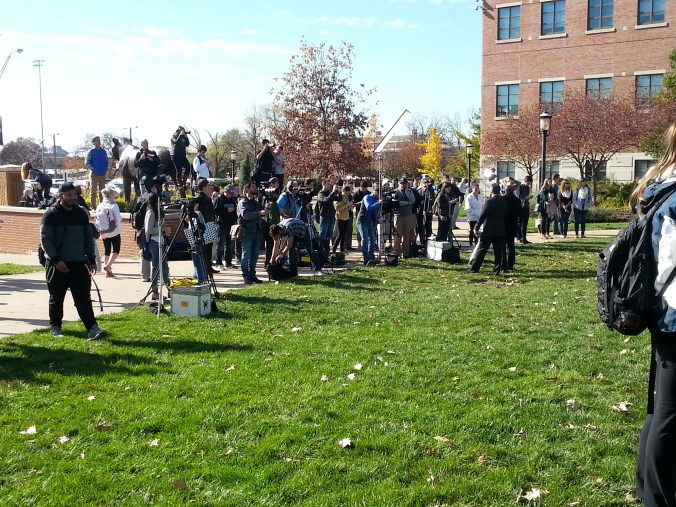
Journalists keeping a respectful distance.


To Be and To Become

There are a few shows I’ve binge watched since the miracle of Netflix began: Orange is the New Black, The Office, and The Walking Dead.

But there is only one show that comes on regular t.v. that I tune in to watch in real-time: Finding Your Roots

Of course, I’m a sucker for any Ken Burns type documentary with sappy music and panning and zoom-outs of black and white photos, but the part I really stick around for is the DNA result. I don’t care who the celebrity is. I just care about that family tree. And I picture my own with a million question marks.

When people ask me why I write, or what made me start writing, I usually don’t have a satisfactory answer. But tonight, I think I have it. My whole life I’ve been searching for my own narrative. My own place in the story of the human experience.

If you know me, we’ve probably talked about this. Or, if you know me a little less, maybe you’ve read about this. I’m a Holzhauser. I emulate all of those characteristics; I’m stubborn, competitive, sarcastic, and a smart-ass. I am proud of my German heritage, whatever that means, and for me, it means growing up close to Hermann and being able to pronounce your last names. It means knowing what happens in October and May and loving meat and potatoes and having cuckoo clocks chiming at my house.

But, of course, my whole life I’ve known I’m not really a Holzhauser. I don’t look like them. Genetically, we are nothing. Am I even German? My mom’s side is Polacek, a Bohemian name. My grandmother wore scarves like any Eastern European immigrant. I am also not her. I’m neither my mom nor my dad. Their stories live through me, but not the way your family’s stories live in you.

I know that’s hard for you to hear. It’s hard for me to remember. Every. Single. Time. But this wanting to know, this knowing that there was another, distinct path my life didn’t take, is what made me start imagining. As a child, it seemed there was another me living in a parallel universe. With people who looked like me. In my mind, they were all blonde.

As it turns out, they really are.

I met my biological mom in 1999. I’ve tried so many times to write about it in a coherent way, in a way that people might be able to read it, but it’s hard. I also met my two half-sisters. I know their names. In fact, we were friends on social media for a while. Until my bio mom unfriended me and the family followed suit. Why? I think because I date women. She never really told me.

From the magic of social media, I’ve found out recently that one of my half-sisters is now a student at Mizzou. She looks like me…if I spent a lot of time in the mirror each morning. She was a high school athlete. From what I’ve seen, we shoot a basketball exactly the same. And though we hung out once when she was 7, she has no idea who I am. I always told myself I’d tell her when she was 18. I haven’t yet.

If you’re curious, I have 5 half-siblings from what I can research. One brother, the rest sisters. As an only child, I can’t even.

You’re probably not adopted. You probably have no idea what I’m feeling. I mean, you’re trying to imagine, but you probably can’t. The same way I can’t imagine growing up with people who share my DNA. Who look like me. Siblings who say, “you’re adopted,” as some strange insult.  I never understood why that was bad.

It is because of my adoption, and that curiosity of a life that never was, that I started imagining the life that could’ve been.

Growing up, I suspected EVERYONE of being my relative. I kept and open mind and wild imagination. Both Laverne and Shirley were once, in my mind, my biological mom.

Maybe that is what fueled my interest in people and cultures. In the living and dead. In evolution. We all come from one African mother, anyway. We’re all related somehow.

For my birthday this year, I bought myself a DNA test. I’ve been wanting to and putting it off for years. This test will tell me exactly how white I am. From which regions of Europe my relatives come.

Which I’ve just realized might be the opposite of what I want. Right now, there are possibilities. I could be from anywhere. Somewhere, way back there, we come from the same people. Until the results arrive, I am an Everywoman.

I’ve done some digging with the little information I have. From what I can figure, casually, and through a website, there are a lot of Patriots and Irish in my bloodline. From what I’ve seen, I’m as white-American as a girl can be.

Maybe you’re wondering why it even matters. I know people who are adopted who give zero fucks about their biological history. I know people who aren’t adopted who feel the same way. I know there are others still whose paper trails ends and begins in the 1860’s. And some even, have no papers at all.


I, and two other writers, gave a presentation last night about our anthology. A question was asked, what it meant to be Southern. For me, it means to love and hate the place I come from. To be a part of the landscape of a flooding river and the smell of deer blood in November.

Maybe the cells in my body are the first in my genetics to experience these things. Maybe that’s why I can’t let go. Or maybe my cells hold the memories of everyone before.

Maybe I’m already rooted firmly in place.


Little White Lies

On Monday, I chose to be part of the revolution, or at least, show my support of Concerned Student 1950. I canceled class and encouraged my students to see the change that was about to happen on campus. I didn’t know what was going to happen, but something had to.

I saw social media posts from only white people saying how irresponsible it was of teachers to cancel, when they are being paid to teach. I can’t think of anything I teach in my composition class that is more important to teach students than a civil rights movement in their backyard.

Tuesday night was scary. There were reports and rumors about all of the things happening on campus: the anonymous threats of violence against black people turned out to be true and two people were arrested. But before that, students were emailing me, concerned for their safety. I stayed up pretty late trying to be informed about what was happening. I heard that the KKK was on campus; this turned out to be not true, or at least, unconfirmed. I heard, third hand, that there were white guys in trucks waving confederate flags and shouting at black people. I believe that, even if it wasn’t caught on film. I believe someone when he tells me someone shouted something racist at him. Whether I saw it or not. Whether he called the cops or not. Whether it was tweeted or not.

I’d like to teach you some vocabulary.

Nigger Knocking: is when you knock on someone’s door or ring the bell and run away.

Nigger-Chaser: is a bottle rocket when you’ve ripped out the stem

Nigger Rigged: is when you’ve fixed something half-assedly, or temporarily.

Nigger: any African-American, or my white cousin since she tanned so easily

Nigger: something you call someone when you’re playing around, the way you would use the word, “asshole.”

I know these definitions because I heard these words and sayings my entire childhood. Well, that’s not exactly true; most recently I heard that awful word from a second cousin, just back in September, when he was trying to tell some story. I said, “No. We’re done.” And I walked away from him.

And you might remember last Thanksgiving when I wrote about my cousin joking about “coon hunting” in Ferguson. What you might not know is, not too long after that, I received a message from his mom (my first cousin by marriage) wherein she told me I should’t’ve chastised him in public (on my blog) because he has black friends (and by the way, they are very educated), and then I was told that the family had been very tolerant of my “choices” and had treated all of my “friends” with respect because they loved me.  I’m still trying to unpack all of this. I guess the logic was I should tolerate his racist comment (or not put him on blast, though I never used his name) because they were never mean to my girlfriends. And wife. Don’t forget I was illegally gay married for a large part of that.

One of my family’s favorite stories about my grandpa is, apparently, the time Sammy Davis Jr. and Nancy Sinatra performed together on some tv show. Grandpa was a big fan of Nancy. The story goes that at the end of the song, she kissed Sammy Davis Jr. and so Grandpa got up from his chair, turned off the gotdamn tv and never listened to her again. He was one of the people I remember using that horrible word the most.

Did I ever tell you about my white high school? One person at my school had a black dad. One. And when her boyfriend, who happened to be black, came to see her one day, a group of white guys got up to blockade the door. To confront him. All these guys wore confederate flags, either on shirts or belt buckles, and boots. They threatened him. His kind was not welcome here. Is what they actually said. The principal told him to leave, for his own safety. I heard that later he came to a basketball game and was beaten up. There were no cell phones in those days. Did it really happen?

In her last weeks on earth, my grandma told me that my aunt had a crush on some guy. But she couldn’t date him because he was “colored.” I knew my grandma was using some antiquated language, which, to her, was a respectful term. So, I just said, “why can’t they?”  To which she smiled, shrugged her shoulders and said, “You’re right. It doesn’t really matter, does it?” See. People can change.

More vocabulary:

A faggot is a guy who can’t play sports.

A dyke is a girl who can.

A fag-tag is that strange loop that appeared on men’s shirts in the late 80s.

Gay-wad was also a popular word when I was younger.

My students still say something is “gay” if it’s stupid.

There have been times when horrible words were used against me. I’ve feared for my safety because of who I am. Because of a part of me that I cannot change.

  1. I came to school and found the word “Dyke” keyed into the paint of my gym locker. I told teachers. It was infuriating and hurtful. My school had less than 250 students. I knew them all. The people who did it were people I’d known my whole life. I wondered what strangers might do to me. No one in administration spoke to me about it. The next day it was painted over like nothing had happened. I understood the message: We don’t care that this happened.
  2. I was in Houston. Kissing my girlfriend on the sidewalk. A truck drove by. With two white guys who yelled, “Fucking dykes!” And sped off. It’s not just what they said, but the growling hate in their voices when they said it. We were scared and went home.
  3. Walking outside a mall in St. Louis alone at 5:30 in the afternoon. A Jeep full of white guys, college age, drive by me, honk, and all in unison yell “FAG!” at me. I stopped. As they drove off, one turned around and said, “Oh, shit. It’s a chick.” I was shaking. There were so many of them. I went to the mall and had one of my first panic attacks.

I don’t have pictures of these incidents, but I keep them with me wherever I go. In public with my girlfriend, I look around to see how many people might care, or how many people might do something about it.

Does that count? Does that prove to you that homophobia exists? If your lesbian friend is harassed on the street when you’re not there, does she make a sound?

Think really hard and you’ll recall some times when your friends did something like that, to be funny. Or told a story about a time they did. If you’ve never experienced anything like this, you’re privileged. I’m privileged it’s happened only a few times. If you’re white, you’ve heard those racist comments and jokes, maybe not aimed at anyone specifically, but you’ve heard them. Or you’re lying.

If I came to you during any of these times and told you what happened, you wouldn’t blame me for feeling really, really shitty. When someone in a position of power, a white man, yells a word at you that’s been used to oppress, well. That is a scary and dehumanizing thing.

Privilege is being able to count those experiences on one hand.

I was 19. It was some fast food place in Houston. My girlfriend and I walked in, ordered, and sat down. We started eating. But something felt strange. I looked around. The place was full. We were the only white people. I was shocked. I’d never before experienced that. I was ashamed.

I minored in sociology in college. I took an African-American studies class. I was the only white person. I was afraid to speak up in class, even when I knew the answers. I was afraid to talk to people. I made no friends in that class. I thought everyone hated me.

I took another class: Mexican-Americans in Houston. I was the only white person. One of the assignments was to interview a Latino artist in Houston. The whole class started talking to each other about who they might interview. I almost cried. It felt so unfair. How was I supposed to find someone like that?

Then. I got it. As much, I think, as a privileged white girl could. I don’t pretend to know what it means to be black in America, but I’m doing my best to try.

In my experience, the best way to be an ally comes in two easy steps.

  1. Listen Up

This step is hard because it means shutting up. When I learned of the walk out, I tried to find out all of the information I could before forming an opinion. I’m new to campus, have never experienced racism there, and had heard nothing about it. That doesn’t mean I don’t believe it happens. Of course it happens. As the information rolled in, I educated myself about the history of campus. I read so much to understand.

  1. Speak Up

Those vocabulary words I gave you are still being used where I’m from. They’re used where you’re from, too. You’ve heard them recently. Your family members have said them and you felt awkward and walked away. Or maybe you just sat there and kept pretending to listen when all you could hear was blood rushing into your ears. Maybe you have no idea about what’s happening on campus and you don’t want to “take a side.” Fine. But there are things you need to be doing anyway, in your home, at that holiday dinner. When someone says one of those things, say something. Make the situation uncomfortable. Call people out. It doesn’t get easier, but it does get better.

To be honest, I’m nervous about posting this. All of the hate that’s been going around is contagious and disgusting. But. This is what I can do to speak up.

It’s never easy.

There’s one more word I could put in that first vocabulary list. I’ve been called it a few times. And this post might prompt someone to think it of me. If you know what word I’m talking about, then you might be someone who needs to listen up.


My Gay Timeline Part II: 17 Years of Coming Out and Out and Out and Out and…

This weekend I was fortunate enough to be on a panel at the Southern Festival of Books in Nashville. There were 5 of us there, writers of Crooked Letter I: Coming Out in the South, to talk about the book and our experiences.

If you haven’t read it, and I’m guessing you haven’t, it’s not hard to tell what the anthology is about: coming out. The more I say that phrase, the more tired I become.

An audience member asked a question that still has me thinking. Chu asked, “Isn’t coming out something that you have to do more than once? Like, any time you meet someone?”

The answer: YES. Every.Single.Day.

When I first realized I was gay (or different, in some way, from others), I wore all the rainbows I could find. I had necklaces and bracelets. Shirts, too. Some funny, some offensive. I made it my goal to make others see me. To see that there are people like me (whatever that meant or means now). I loved watching peoples’ faces as they saw my Lez/Pez shirt and would either smile or snort their disapproval. My other favorite shirt I can’t seem to find any iteration of on the internet; it was basically the women’s bathroom symbol with boobs. Two of those. 69-ing. It read “porn star.” And my first offensive shirt I made in high school. I tore the bottom off a white t-shirt, so it was a crop top and wrote on it, in sharpie, “FAG.”  Mom ended up throwing that one away soon after I wore it to a coffee shop in Jeff City. She denied every touching it.

But my point is, I used to do that. I used to love doing that. I needed to do that. I wanted to be seen. I wanted to make that statement. I’m gay. I exist in the same world as you. Deal with it. My clothes and bracelets did all my coming out for me, I guess.

But now. I don’t want to come out any more. If you’ve never experienced this, let me try to explain all the ways we have to come out.

In the classroom: “Professor Holzenfluken, do you have any kids?”  I have a son. “Are you married?”  No. “Does his dad live close?”

And here is where I have to chose to come out or not. If I leave out the pronoun and say, “Yes.” I’m lying. To myself. Denying Cyrus’ true family. Not doing my part as a gay person to make sure people know we’re everywhere (more on this later). So I make the choice to say, “he has another mom.”

Then the barrage of personal questions about how we made a baby. And you know, no one ever asks a straight couple how they have a baby. And here is where I feel that obligation to educate. I could say, “none of your business,” but if I do, then I’m a bitchy dyke or they don’t learn a damn thing. So I take the time to explain because I’m probably the first person they’ve met who’s had that experience. It’s exhausting.

At the doctor: “Okay, just put your feet in these stirrups and scoot your butt down…more…more…more…more. Okay. So, I see you’re not on birth control; what methods are you using for family planning.?”    Sigh. I have sex with women. I told you last time. Doesn’t anyone write that down?

At another doctor: “So, you’re cramping and feeling nauseous, huh? We’d better do a pregnancy test.”  I’ve never had sex with a man/I haven’t had sex with a man in 5 years. Beat“Well, better safe than sorry.”

At restaurants: “Separate checks, then?”  Sigh. Together, please.

Walking with a partner anywhere: Can we kiss here? What happens if we do? Maybe we can just hold hands? We probably shouldn’t. You know. Just in case. Hands touch momentarily. Loving look exchanged. Person walking by frowns. 

In your own home: Repair guy shows up. “I have to leave, but my…(wife? girlfriend? friend? roommate?) will be home in just a few minutes.” Raised eyebrow.

At the bank: We’d like to buy a house. “I see.” -Fumbles with papers-

Most of you might say, “Well, fuck them.” But you’ve never had to do this. Weekly.

At this age, my sexuality is the lowest on my list of my identity. I hope, too, that if you describe me to someone, you wouldn’t include this part of me in your description. Just like I wouldn’t say, “Jane Doe? Yeah, she has black hair, is tall, she fucks guys. Loves it.”

There was a moment this weekend, when I was speaking on the panel, when I said, “Everyone in this room has a different sexuality. We all like different things. But not all of you are asked to explain yourselves. And it’s really no one’s business”

My sexuality is not my lifestyle just like yours is not your lifestyle. It means nothing to me until I have to explain it or justify it.

It’s the same for you. How often do you sit around wondering about your intense love of being on top? Or being tied up? Or tying someone up? How often are you asked to reveal that part of yourself?

Another thing I was asked to think about this weekend is my job as a queer educator. Questions from the audience members were somewhat political, asking what was next for the LGBTQ movement. Did we think that things will get better soon? What advice do we have for parents and friends of those coming out?

Honestly, I have no idea. I write and teach English and dig holes in the ground. I’m not a spokesperson for The Gays. I’ve done my part; I did that for years. Now. I just want to relax and raise my son. I want peace and quiet. I want to watch Netflix and go to bed at 9:45.

I feel some shame in that. If I quit making people aware, who will? If I don’t force myself to hold my girlfriend’s hand in Callaway County, how will people become used to it? Because I’m still afraid to do that… in most counties. Because, despite my tough rugby persona, I don’t like to be looked at or snorted at or made fun of or called a dyke by a Jeep full of fratboys. Because words are still very powerful.

And the silence of our loved ones is louder.

35755

Homeward and Bound

I want you all to know that I just had an amazing weekend. I was in Decatur, GA for the Decatur Book Festival. I was there to sit on a panel about the new anthology I’m in: Crooked Letter I. During my stay, I met the most amazing people. Writers. And I was reminded who I am, who I want to be, who I’ve always been.

When I landed at the St. Louis airport today, Mom texted me to remind me that the Mokane World’s Fair was happening. If you’re not from around those parts, Mokane is a town of 247; it’s where I went to school. K-12. And this fair, of course, is small, but growing up, it was a big deal to go there and kiss my 8th grade boyfriend in the dark, beneath the ferris wheel lights while all the parents played bingo.

Today was the “Old Time Fiddler’s Contest.” It’s held every year, and people from around the state come to compete. There is a Junior division. That means kids of, like, 7 or 8 fiddle, too. I drove straight there from the airport because Cyrus loves music and fiddles, and Mindy was taking him to see them.

mutton

“You ain’t nuttin’ til you eat mutton”

It was in the middle of this fiddling, in the 95 degree sweat rolling down the small of my back, that I became moved. In my head, I was writing a piece about white culture. You see, I told my girlfriend this weekend, who is Venezuelan-American, after having met so many talented women of color at the festival, that I wasn’t anything. That I was just white. And she said to me, “Your color is white and it is beautiful. You challenge the cultural conception.” It was a sweet thing to say. I love her. So I sat there watching this small child with a German last name play her fiddle while wearing a cowboy hat and Wranglers. I thought to myself as I looked around at all the older people enjoying the music, this is where I’m from-this is a culture worth something. I was composing an essay, finally, praising my upbringing. We are a people of German heritage and kindness and fiddles and biscuits and gravy. I come from a people who work hard, who don’t mind sitting out in the heat to listen to a child play “She’ll Be Comin’ ‘Round the Mountain” at varying speeds. Old men in their bib-overalls and work boots. The women fanning themselves and smiling.

fiddler

Fiddlin contest

This, I thought, this is me. This is home. 

And then.

Cyrus became bored with the fiddles, as a five year old does. We walked out of the pavilion and sat with my dad and a distant cousin of mine. The cousin pulled out his phone, “Isn’t this girl your twin?” He said. The girl in the picture was white and had a lip piercing. She wore a backward baseball hat. “I look like her because we’re both lesbians, right?” He said something about how she was also attracted to him. My mind drifted. Then he started in on a story that I couldn’t quite follow…”then we were down on Broadway, you know, where all the niggers are…”

I write this word in its entirety because it is the way I hear it. Loud. Grating. Awful.

With this I said, “No. We’re done,” and walked off.

I circled the fiddle contest area, running my hands through my already greasy and sweaty hair. White privilege means a lot of things and this is one of them: this fucked up privilege–this assumption that, because I’m white and from a small town, this word is okay to say in front of me, that I feel the same way, or that this is just what we say.  I felt bad for walking away because my dad was stuck there, listening to the rest of the story or apologizing/explaining why I walked away mid sentence. But I couldn’t stay. I never can.

So I calmed down and went to get another Bud heavy.

I came back, only after I’d made sure he was gone, to stand with my parents and my aunt.

And then.

A woman walked up to us, apparently a friend or coworker of my mom and my aunt. They joked she looked so nice since she wasn’t soaked in sweat. Mom introduced her to me, “she worked out at the state hospital, too.” I said hi. The woman started in with, “well, I’m not sure how long I’m gonna work there; there’s a lotta stupid people out there now.”  I nodded my head and sipped my beer.

And then.

“All those damn foreigners can’t speak any gotdamn English…”

I said, rather loudly, “I have to leave now.”

I walked off, choking back tears. I heard my parents say good-bye, and I gave them a wave without turning around. All the warm feelings I had earlier, about the fiddles and old men in overalls, all those washed away. Or were sweated out. Or were soaked up by the sun. Something about heat.

That is where I come from, though it’s not where I fit. Like everyone, my whole life I’ve been searching. I’m adopted. I’m queer. I’m white. I’m a writer. I’m an athlete. I’m from the smallest town on the planet.

This weekend though, among the writers, I felt snugly in place. But the woman and modest mid-westerner and Southern way of putting myself last always creeps back. Among Jamaican-American, Palestinian-American, Japanese-American, African-American women, what could I possibly say that is different or worthy?

My name is Christina. I’m no different but different from you. I’m starting here.

eyes

The drive home.

Flying Flags, Burning Bridges

I grew up in a town of 150 people (1980 Census, now 85 people) in the middle of Missouri. Where I’m from, the stars and bars are everywhere: t-shirts, bandannas, bumper stickers, flags on porches, wallets, belt buckles. I grew up here, but not ever have I worn this flag to display my proud white heritage. I’ll tell you why.

To me, the confederate flag means bad things. It means hate. When I see a confederate flag, I go the opposite direction. Why? Because some of those wearing that flag called me a dyke, a pussy eater, a fucking faggot. Because those were the people in school who called black people niggers and said a lot of other, awful, ignorant and racist things. Because they beat up said black people for being alive. Because people wearing that symbol harassed the one person in our school who happened to be black. And. Well, really, I think that’s enough.

Now, am I basing my judgement of something on only a few people? No. Not a few, but thousands, as this was my experience from ages 0-35. I’m basing this opinion on a lifetime of negative experiences because I have never met one person in my life who wore a confederate flag with the words, “the south will rise again!” (or had one tattooed on their chests, or taped to their truck, or painted on his belt buckle) and wanted to discuss the richness of southern cuisine, dialects, fashion, sense of family or faith, or community. If that person exists, I’m very, very interested in speaking with him or her.

Of course, there’s the rainbow flag, too. Which, to me, used to mean I was accepted and welcome. The first one I saw was above the Peace Nook here in Columbia. The year was 1997 and someone had to tell me what the rainbow meant. I became fascinated and began to look for rainbows everywhere. It meant there were more people out there like me who held some of the same beliefs, who, if they saw me wearing a rainbow, could immediately identify me as one of them. But as I’ve grown older and have experienced people harassing me because of it (yes, some of those people were wearing that other flag), people who were sexually aggressive (so much that I had to run), people who told me I was going to burn in hell, I avoid rainbow flags and necklaces and bumper stickers. Because it just makes me an easier target.

I also realize that the rainbow flag, to some people, reminds them of dildos or drag queens dancing to club music. Which they may not like. But, hey, at least those are fun and inclusive.

Any flag or symbol helps to identify and make one feel a part of something bigger than themselves, but it also makes one a target. Yes, for all groups.

Having grown up in Missouri, I’ve heard arguments on both sides whether or not my state is southern. If you know me, you know I argue that it is based on food, slang, and political views and affiliations. Based on social conservatism and that fact that coming out meant some of my friends and family treated me with Bible verses, derogatory names, and utter silence.

That’s southern.

So what’s the difference between flying these two flags? One stands for something that has passed, for a country that struggled to exist, whose ideas were already antiquated and strove to keep millions enslaved, and one stands for new ideas, for hope to come for a group of oppressed millions. I’ve seen southerners fly a rainbow flag, but never gay southerners (who are very proud to be southern) fly a confederate flag.

Taking down the stars and bars doesn’t immediately change the racism rampant in our country, and it does’t mean that Americans aren’t appreciative of southern culture. Raising a rainbow doesn’t change homophobic opinions or ensure the safety of LGBTQ people.  It also doesn’t mean gays are running the world.

I’m not proud to be a white southerner. I’m not proud to be gay. I’m proud to be Christina-who happens to be a white girl from the south and who happens to be attracted to women. I’m proud to be a world citizen who now, finally has some of the same rights you have always had: the right to marry, on paper, someone I love.

So, gentle reader, until the confederate flag is the symbol of sweet tea and gramma’s fried chicken at a Sunday meal, and no one calling my significant other my “friend,” and without anyone saying “(insert any racist term here),”  then I just can’t get behind it.

images